

A cart abandonment email flow is an automated sequence triggered when a shopper adds items to their cart but doesn't complete the purchase. A well-built three-email flow recovers revenue by removing the real reasons people don't buy—distraction, hesitation, and friction—without discounting. Most brands underperform not because their timing is wrong, but because they've built a flow that trains customers to wait for a coupon.
Here's the pattern we see constantly: a brand builds a three-email cart flow, puts a discount in email three, and watches their "recovery rate" climb. What's actually happening is a segment of their list has figured out the game. They add to cart, abandon on purpose, wait 48 hours, and pocket the discount. The brand celebrates the conversion. The margin quietly disappears.
This article gives you a different architecture. One that recovers revenue by removing the real reasons people don't buy—distraction, hesitation, and friction—without turning your best customers into coupon hunters. We'll cover the framework, the three-email sequence, the Klaviyo setup, and how to diagnose a flow that's live but underperforming.
What Is a Cart Abandonment Email Flow—and Why Does the Default Playbook Fail?
A cart abandonment email flow is an automated sequence triggered when a shopper adds items to their cart but doesn't complete the purchase. The default playbook—reminder at one hour, nudge at 24 hours, discount at 48–72 hours—works in the short term but creates a compounding problem: it trains repeat customers to abandon intentionally, knowing a discount is coming.
Abandoned cart rate is the percentage of online shopping sessions where a customer adds items to their cart but leaves without completing a purchase. The abandonment itself isn't the problem. According to the Baymard Institute (2024), roughly 70% of online shopping carts are abandoned. That number has been stable for years, which tells you something: most people browsing online aren't ready to buy. They're comparing, browsing, or saving for later. A cart abandonment flow doesn't convert every one of those people—it recovers the ones who had genuine intent but hit a friction point.
The distinction matters because it changes how you write the emails. If someone abandoned because they got distracted at work, a simple reminder works. If they abandoned because they weren't sure the product was right for them, they need a different kind of reassurance. If they abandoned because shipping cost more than they expected, neither a reminder nor a social proof email will convert them—you need to address the cost directly.
Most cart flows send the same email to all three of these people. That's the first problem. The discount in email three is the second—it solves for the price-sensitive abandoner at the cost of training everyone else.
The Cart Recovery Hierarchy: Why Do Customers Actually Abandon?
Before writing a single email, map your cart abandoners into three categories: distraction (they got pulled away with genuine intent), hesitation (they want the product but haven't resolved an objection), and friction (a practical barrier—shipping cost, payment issue, or trust gap—stopped them). Each category requires a different recovery approach, and treating all three identically is the core reason most generic flows underperform.
This framework—the Cart Recovery Hierarchy—reframes cart abandonment from a single problem into three distinct problems. Treating them identically is why generic flows underperform.
Level 1: Distraction Abandoners
- Who they are: High purchase intent, interrupted by something external (a meeting, a phone call, the kids)
- What they need: A simple, frictionless path back to checkout
- What to send: Cart reminder with product image, price, and a single CTA. No persuasion needed—they already decided.
- Discount needed: Almost never
Level 2: Hesitation Abandoners
- Who they are: Genuine interest, unresolved objection—product fit, quality uncertainty, "is this really worth it?"
- What they need: Objection removal through social proof, product education, or explicit FAQ answers
- What to send: Email that addresses the most common objection for that product category, backed by reviews
- Discount needed: Rarely—confidence is the gap, not price
Level 3: Friction Abandoners
- Who they are: Ready to buy, but a practical barrier appeared at checkout—shipping cost surprise, payment method, trust concerns
- What they need: Friction removal (free shipping threshold, trust badges, alternative payment options)
- What to send: Direct acknowledgment of the barrier with a clear solution
- Discount needed: Sometimes—but free shipping often converts better than a percentage discount at lower margin cost
You don't need complex segmentation logic to start applying this framework. The simplest version: use Klaviyo—an email and SMS marketing automation platform built for ecommerce, offering flow builders, segmentation, and performance analytics—to add conditional splits that separate first-time abandoners from customers who have abandoned and received a discount before. Route the latter group to a non-discount track. Over time, you can layer in product-category-specific messaging for the hesitation segment.
For readers building their first flow from scratch, the broader abandoned cart email strategy covers how to approach this architecturally before you get into Klaviyo.
Should You Offer a Discount in Your Cart Abandonment Flow?
For most DTC brands, discounting in cart abandonment is the wrong default—not because discounts don't work, but because they work too well on the wrong segment. Customers who abandon repeatedly have learned that waiting gets them a discount. Isolating these repeat abandoners from your discount track is more valuable than the incremental conversions the discount generates.
Here's what happens at scale. A brand runs cart abandonment with a discount in email three. Their reported recovery rate looks healthy. But inside that number, there's a segment of customers—often a meaningful share of recovering carts across the programs we've audited—who have abandoned two, three, or four times and always converted after the discount email. These aren't customers you saved. These are customers you trained.
The operational fix is a flow filter in Klaviyo: exclude any contact who has received a cart abandonment discount in the last 60 days from the discount branch. Route them to a non-discount sequence instead. For brands with Shopify, you can also filter by order count—customers with two or more orders who abandoned are less likely to need a price incentive and more likely to be playing the discount game.
The discount train effect is real: a meaningful segment of cart "abandoners" have learned that waiting 48 hours earns them a discount. When you isolate first-time abandoners from repeat-discount recipients, conversion rates look very different—and your margin math changes completely.
The brands where non-discount cart recovery works best share a few traits: strong product-market fit, reviews that do the objection-handling work, and products with a clear differentiation story that doesn't require a price cut to close. If your product's main value proposition is price competitiveness, discounting makes more sense. If your product is premium and your reviews reflect that, you're leaving positioning on the table every time you send a discount email.
If any of this sounds like your current flow—or you're not sure how much your discount dependency is costing you—we'll audit your cart flow for free. We look at timing, sequence architecture, discount dependency, and where the actual conversion leakage is happening.
What Does a High-Converting 3-Email Non-Discount Flow Look Like?
A three-email non-discount cart abandonment sequence works by matching each email to a specific psychological moment: email one removes distraction and resets context (sent at 60 minutes), email two resolves hesitation with social proof and urgency signals (sent at 24 hours), and email three closes with value anchoring and confidence—not desperation (sent at 72 hours).
This is the architecture we use as the default starting point for brands that want to protect margin while recovering revenue. Here's how each email is built:
-
Email 1 — Cart Reminder + Objection Removal (60 minutes post-abandon)
Lead with the product. Show the image, the name, the price. Then add one short paragraph that addresses the most common objection for that product category. For a skincare brand, that might be skin type compatibility. For a supplement, it might be "when will I see results?" For an apparel brand, it's often sizing and fit. Keep it short—two or three sentences, then a single CTA back to checkout. No discount, no manufactured urgency. This email converts distraction abandoners who are already sold; the objection line catches the hesitation abandoners starting to drift.
-
Email 2 — Social Proof Anchor + Real Urgency (24 hours post-abandon)
This is where you bring in your best reviews. Not generic five-star quotes—specific reviews that address the hesitation you identified in email one. If email one handled the sizing objection, pull a review that says "the fit was exactly what I expected." Pair the reviews with a real urgency signal: low stock for that SKU (only if it's true—never manufactured), a cart expiration window, or a shipping deadline. The psychological mechanism is validation plus a soft reason to act now. No discount.
-
Email 3 — Value Close (72 hours post-abandon)
This email doesn't push harder. It reinforces the product's core promise and closes the loop on any remaining objection. Think of it as a confident summary: here's what this product does, here's why it's worth what it costs, here's what happens when you order today (fast shipping, easy returns, satisfaction guarantee). The tone is assured, not desperate. If someone makes it to email three without converting, they're likely a genuine hesitation abandoner—this email gives them one final, confident nudge without cheapening the brand.
The same structural principles that govern this sequence—timing logic, conditional splits, and entry/exit rules—apply across your entire lifecycle program. Our guide on welcome flow architecture covers those foundational mechanics if you want to understand the system-level logic before building in Klaviyo.
What Are Realistic Cart Abandonment Flow Conversion Rate Benchmarks?
Flow conversion rate is the percentage of contacts who enter a cart abandonment sequence and complete a purchase before exiting. In our experience across DTC programs, a healthy flow typically converts somewhere in the range of 5–12% of abandoners across the full sequence, though this varies significantly by product category, AOV, and list quality. Email one (the 60-minute send) consistently drives the largest share of total flow revenue—making it the highest-leverage optimization point in the entire sequence.
Here's what benchmark performance looks like by email position, based on our experience across DTC programs and published platform guidance:
Conversion Rate by Email Position
- Email 1 (60-minute send): Highest individual conversion rate in the sequence. In our experience, the majority of flow revenue is generated within the first 24 hours of the trigger. Speed matters: Klaviyo's platform data consistently shows that cart emails sent within the first hour significantly outperform those sent later.
- Email 2 (24-hour send): Typically drives meaningful incremental conversion on top of email one. Adding social proof in this position is the highest-leverage content choice.
- Email 3 (72-hour send): Usually contributes the smallest incremental lift of the three. The marginal gain here is smaller—which is why adding a discount to email three feels impactful but often just accelerates conversions that would have happened anyway.
- Revenue per recipient (RPR): In our experience working across DTC programs, RPR tends to vary widely by AOV and product category. Higher-AOV programs typically see stronger RPR figures; lower-AOV programs see correspondingly lower numbers. If your cart flow RPR is trending down, the issue is almost always in email one.
Revenue per recipient (RPR) is the average revenue generated per email delivered in a flow, calculated by dividing total flow revenue by total emails sent. It's a more useful optimization metric than open rate because it accounts for the full conversion chain—opens, clicks, and purchases—in one number. If your cart flow RPR is below your baseline expectations, the problem is almost always in email one: timing, copy, or the product display.
A fourth email is rarely worth adding. In our experience across DTC programs, a fourth cart abandonment send recovers negligible additional revenue while increasing unsubscribe rates and creating brand perception risk. Three emails over 72 hours is the right default architecture for most brands.
How Do You Set Up a Cart Abandonment Flow in Klaviyo?
In Klaviyo, a cart abandonment flow is triggered by the "Started Checkout" or "Added to Cart" metric, filtered to contacts who have not placed an order within the time delay window. The key setup decisions are trigger selection, flow filters for discount exclusion, and conditional splits for customer LTV segmentation—all of which determine whether your flow recovers revenue or trains bad behavior.
A conditional split is a logic branch inside a Klaviyo flow that routes contacts down different paths based on whether they meet a defined condition at the moment they reach that step. Here's the setup sequence:
- Choose your trigger. Use "Added to Cart" if you want to capture early-stage abandoners, or "Started Checkout" for higher-intent abandoners who entered shipping or payment info. For most brands, "Started Checkout" is the right starting point—it's higher intent and less noise. You can add a browse or cart-stage flow later.
- Set the trigger split. Add a time delay of 60 minutes before email one fires. Inside that delay, add a conditional: "Placed Order → Yes, in the last 60 minutes" → exit the flow. This ensures you don't email someone who completed checkout while the delay was counting down.
- Add flow filters. At the flow level (not the individual email level), add a filter: "Has not placed an order since starting this flow." This exits converters automatically at any point in the sequence. Add a second filter: "Has not received email 'Cart Abandonment Discount' in the last 60 days"—this is how you route repeat-discount recipients to the non-discount track.
- Build the conditional split for discount vs. non-discount. After email two, add a conditional split based on customer order count or LTV. Contacts with zero prior orders who haven't converted by 48 hours are your most legitimate discount candidates. Contacts with one or more prior orders go to the value-close email three instead.
- Shopify integration note. If you're on Shopify, Klaviyo's "Started Checkout" event pulls directly from Shopify's checkout initiation. Make sure your Klaviyo-Shopify integration is passing the cart line item data—product images, names, and prices—so your email one dynamic product block populates correctly. Broken product blocks are the most common email one failure mode we see in audits.
A/B testing is the mechanism for optimizing this flow after launch. The highest-value tests, in order: (1) send timing for email one—45 minutes vs. 60 minutes vs. 90 minutes; (2) subject line hook type for email one—curiosity vs. direct vs. benefit-led; (3) social proof format in email two—quote-style reviews vs. star rating + short review vs. UGC photo. Run each test for 30 days minimum and use RPR, not open rate, as your winning metric.
The segmentation logic that makes these conditional splits work is the same system that powers your broader lifecycle program. Our guide on browse abandonment flow covers how the distraction-type abandoner from the Cart Recovery Hierarchy is actually better served by browse-level messaging—worth reading if you want to connect the two flows.
Why Is My Cart Abandonment Flow Live But Not Converting?
The most common reasons a live cart abandonment flow underperforms: email one is firing too late (over 2 hours post-abandon), the product block isn't rendering correctly due to a Shopify-Klaviyo sync issue, the flow filter excluding recent purchasers is misconfigured and sending to people who already bought, or the copy is generic and doesn't address the specific objection for that product category.
Run through this diagnostic checklist if your flow is live and conversion rate is below expectations:
- Check email one timing. Pull your flow analytics and look at the time gap between the trigger event and email one delivery. If it's consistently over 90 minutes, your delay is set too long or there's a processing lag. The first-hour window is your highest-leverage conversion moment—every minute of delay past 60 costs you recoveries.
- Audit the dynamic product block. Send yourself a test through the flow and check that the product image, name, and price are rendering. A broken image or missing product name drops click rate significantly. Check your Klaviyo-Shopify catalog sync and confirm product feed data is current.
- Check your flow filter for "Placed Order." If this filter is set incorrectly (wrong time window, wrong condition logic), you may be sending cart emails to people who already completed their purchase. This inflates your send count, tanks your conversion rate, and creates a terrible experience.
- Review your exit conditions. Anyone who placed an order should exit the flow at any point in the sequence. If your exit condition is only at the flow level and not checked between emails, converters from email one are still getting emails two and three.
- Evaluate your copy against the product category. If you're selling a high-consideration product (high AOV, complex use case, multiple SKUs) and your cart email says "You left something in your cart!"—that's the problem. The objection for a premium skincare set is different from the objection for a candle. Generic copy doesn't do the heavy lifting that high-consideration products need.
If you've checked all of these and the flow still isn't converting, the issue is usually upstream: your cart abandonment rate is high because of a broader checkout friction problem (unexpected shipping cost, limited payment options, unclear return policy) that email can partially address but not fully solve. The email marketing without discounting framework covers how to build the broader non-discount revenue strategy that makes cart recovery easier.
Book a free flow audit if you want a second set of eyes on the setup. We'll walk through your Klaviyo configuration, conversion data, and copy against the checklist above and tell you exactly where the leak is.
Key Takeaways
The core principle across every element of this guide: recover revenue by removing the real reason someone didn't buy—distraction, hesitation, or friction—rather than defaulting to a discount that trains customers to game your flow and erodes margin over time.
- Map your cart abandoners to the Cart Recovery Hierarchy—distraction, hesitation, or friction—before writing a single email. The recovery approach should match the diagnosis.
- Email one (60-minute send) drives the majority of cart recovery revenue. Optimize it first, last, and always.
- A flow filter excluding previous discount recipients from the discount track is the single highest-leverage operational change for brands that have been discounting by default.
- Three emails over 72 hours is the right default architecture. A fourth email rarely recovers meaningful additional revenue.
- In Klaviyo, conditional splits by customer order count or LTV are the mechanics that make non-discount recovery scalable without manual segmentation overhead.
You now know what a non-discount cart recovery flow looks like. Building it right in Klaviyo—with the correct trigger logic, flow filters, conditional splits, and objection-matched copy—takes about a day of setup and a week of testing. Or you can book a strategy call and we'll map out your entire cart recovery architecture in 30 minutes.
Frequently Asked Questions
How many emails should be in a cart abandonment flow?
Three emails over 72 hours is the right default for most DTC brands: one at 60 minutes, one at 24 hours, and one at 72 hours. A fourth email rarely recovers significant additional revenue and increases unsubscribe risk. The exception is high-AOV brands with long consideration cycles, where a fourth touchpoint at day 5–7 occasionally makes sense.
When should you send cart abandonment emails?
Email one should fire within 60 minutes of abandonment—this window is when purchase intent is highest and recovery rates are strongest. Email two at 24 hours adds a social proof layer for hesitation abandoners. Email three at 72 hours closes with a value-anchoring message. Delay email one past 90 minutes and you lose your highest-converting window.
What is a good cart abandonment email conversion rate?
In our experience, a healthy cart abandonment flow tends to convert somewhere in the 5–12% range of abandoners across the full sequence, though results vary significantly by product category, AOV, and list quality. Email one typically drives the largest share of total flow revenue. If your full-sequence rate is well below that range, the most common culprit is email one timing or a broken product block—not weak copy in email three.
Should you offer a discount in a cart abandonment email?
Not by default. Discounting in cart abandonment trains repeat customers to abandon intentionally, knowing a discount is coming. The better approach: use flow filters in Klaviyo to exclude contacts who received a cart discount in the last 60 days, route them to a non-discount value-close sequence, and reserve discounts for first-time abandoners with no prior purchase history.
What should a cart abandonment email subject line say?
Email one subject lines perform best when they're direct and low-pressure: "Your [product name] is still waiting," "Did something come up?" or a product-specific benefit hook. Avoid urgency language in email one—it reads as desperate before you've established value. Save urgency signals for email two, and only when they're tied to something real like low stock or a cart expiration window.
Get tactics like this in your inbox every week. We share what's working across our client retention programs. Subscribe to our newsletter →
Need help implementing this?
Let us take the hassle of managing your email marketing channel off your hands. Book a strategy call with our team today and see how we can scale your revenue, customer retention, and lifetime value with tailored strategies. Click here to get started.
Curious about how your Klaviyo is performing?
We’ll audit your account for free. Discover hidden opportunities to boost your revenue, and find out what you’re doing right and what could be done better. Click here to claim your free Klaviyo audit.
Want to see how we’ve helped brands just like yours scale?
Check out our case studies and see the impact for yourself. Click here to explore.

Read Our Other Blogs

Dedicated IP vs Shared IP for Ecommerce Email: When to Switch and When It Backfires



Quiz Funnels for Ecommerce: How to Grow Your List and Segment Subscribers Without Discounts

Klaviyo + Shopify Integration: The Complete Data Sync and Event Tracking Setup Guide

Repeat Purchase Rate: The Diagnostic Framework for Finding Where Your Second Order Is Breaking Down
Apple Mail Privacy Protection: How to Measure Email Engagement When Opens Are Broken

Back-in-Stock Flow: The Highest-Intent Email Sequence Most Brands Never Build

Klaviyo Predictive Analytics: How to Use CLV, Churn Risk, and Expected Next Order Date to Drive Retention

Email Holdout Testing: How to Prove Your Retention Channel Is Actually Incremental

Klaviyo vs Omnisend: Which ESP Is Right for Your DTC Brand in 2026
Dedicated IP vs Shared IP for Ecommerce Email: When to Switch and When It Backfires
Quiz Funnels for Ecommerce: How to Grow Your List and Segment Subscribers Without Discounts
Klaviyo + Shopify Integration: The Complete Data Sync and Event Tracking Setup Guide

How to Repair Sender Reputation: The Recovery Playbook When Your Emails Land in Spam

Abandoned Cart Flow Strategy: Why Your Recovery Sequence Stops Working After Email One

Ecommerce Email Benchmarks: What Good Actually Looks Like for DTC Brands in 2026
Retention-Focused A/B Testing: What to Test in Email When You've Already Optimized the Basics

Klaviyo Segments vs Lists: How to Structure Your Audience Architecture for Scalable Retention

Email Deliverability for Ecommerce: The Complete Guide to Landing in the Inbox

Klaviyo List Hygiene: How to Clean Your Email List Without Killing Your Revenue

Sunset Flow: How to Win Back Unengaged Subscribers Before You Suppress Them

Welcome Flow Optimization: How to Turn New Subscribers Into First-Time Buyers Faster

Popup Strategy for Ecommerce: How to Grow Your List Without Training Customers to Wait for Discounts

Email Offer Architecture: How to Structure Promotions That Protect Margin and Still Convert

Klaviyo vs Attentive: Which Platform Is Right for Your DTC Stack in 2026

Migrating to Klaviyo: The Step-by-Step Playbook for Switching ESPs Without Losing Revenue

Browse Abandonment Flow: The Underbuilt Sequence Quietly Leaking Revenue

Post-Purchase SMS Flow: How to Use Text Messages to Build Loyalty After the First Order

Retention Marketing Dashboard: The Exact Metrics and Reports You Should Be Reviewing Weekly

Agency vs In-House Email Marketing: What Actually Moves the Needle for DTC Brands

SMS Marketing Strategy for Ecommerce: The Complete Guide

How to Set Up Klaviyo Flows: Complete Setup Guide

A/B Testing for Email: What to Test, How to Measure, When to Ship

Email Marketing KPIs: The Only Metrics That Matter for DTC

Email Revenue Attribution: What Klaviyo Gets Right and Wrong

Popup Strategy for Ecommerce: 6 Types That Actually Convert

RFM Analysis for Ecommerce: Segment Your Customers by Value

Email Segmentation for Ecommerce: The 5-Layer Model for DTC Brands

Welcome Offer Optimization: Converting Subscribers Without Deep Discounts

Email Warmup Strategy: How to Build Sender Reputation From Scratch

Email List Hygiene: How to Clean Your List Without Killing Revenue

SPF, DKIM, and DMARC: Email Authentication Explained for DTC Brands

The Complete Retention Marketing Strategy Guide (2026)

Winback Flow: How to Re-Engage Lapsed Customers Before You Lose Them

How to Audit Your Email Flows (The 125-Point Checklist)

Post-Purchase Email Flow: The Architecture That Drives Repeat Buyers

Sunset Flow: When and How to Remove Unengaged Subscribers

How to Build a Welcome Flow That Actually Converts

How to Build an Email Campaign Calendar Without Discounting

Browse Abandonment Flow: Converting Window Shoppers Into Buyers

The Abandoned Cart Email Strategy That Actually Recovers Revenue

How to Build a Welcome Flow That Actually Converts
Personalizing Push Notifications for Better Retention Outcomes
How to Craft Email Newsletters That Build Real Brand Loyalty
Top 3 Best eCommerce Content Management Systems of 2025
Email Marketing vs. Social Media: Which One Should Your Brand Focus On?
Attract More Customers: Which Videos to Use in Your Email Marketing and Why
8 eCommerce Customer Service Mistakes You NEED to Stop Making (Like, Yesterday)
Creating The Perfect E-Commerce Tech Stack

Types of Content eCommerce Brands Need in Their Marketing Mix
Ecommerce Email Mistakes: Blossom Ecom Article on How to Stop Sending Bad Emails & Start Making More Money
Boost Your Bottom Line: The Ultimate Guide to Integrating Website and Email Strategies for Your eCommerce Business
6 Powerful Ecommerce Loyalty Program Examples (and How to Build Your Own)
Loyalty-First Guide to Customer Reactivation Email Campaigns
Using Email Marketing to Supercharge Your Loyalty Program
Unpacking Brand and Conversion in E-Commerce Design
13 Scary E-Commerce Mistakes (and How to Avoid Them)
How to Reduce Your E-Commerce Bounce Rate and Boost Engagement
Combining Content and Commerce for E-Commerce Success
Email Marketing Tips + Trends

E-Commerce Returns Analysis & Crafting a Profitable Returns Policy

9 Pro Tips for A/B Testing Emails with HubSpot
AI and Email Marketing: The Future is Here
How to Skyrocket Your Email Open Rates and Click-Through Rates
Email Isn’t Dead: 4 Reasons It’s Still a Digital Marketing Powerhouse

Email Marketing Series – #3: Building a Strong Email List
Email Marketing Series – #4: 9 Tips for Creating High-Impact Email CTAs

Email Marketing Series – #2: How to Craft Attention-Grabbing Subject Lines
Email Marketing vs. Social Media Marketing — Which Should I Use?
Email Marketing Series – #1: Crafting an Effective Email Marketing Strategy
Email Open Rate: A Practical Guide
3 Effective Strategies to Make Email Your Marketing Heavyweight Champion

How to Attract New Leads with Video in Your Email Marketing
How to Determine the Profitability of Your eCommerce Website
Multi-Channel eCommerce: The Key to Growing Your Online Business
Understanding eCommerce Conversion Rate & Optimization
How to Optimize Your eCommerce Website for More Conversions
Top 3 eCommerce and Digital Marketing Trends for 2025

Optimizing Your Email Marketing Strategy: A/B Testing Explained
35 Eye-Opening Email Marketing Stats You Need to Know
7 Email Marketing Tips to Boost Your SEO
11 Common Email Marketing Mistakes That Are Tanking Your Conversions (And How to Fix Them)
Strategic SEO Tips for Email Marketing: Boost Engagement and ROI
How to Measure and Increase Email Marketing ROI (Plus Templates That Convert!)

Do Lifecycle Email Campaigns Really Drive Conversions? Here’s What We Found
How to Use Remailing in Your Email Marketing Strategy

B2B Email Marketing: Building Relationships and Converting Leads
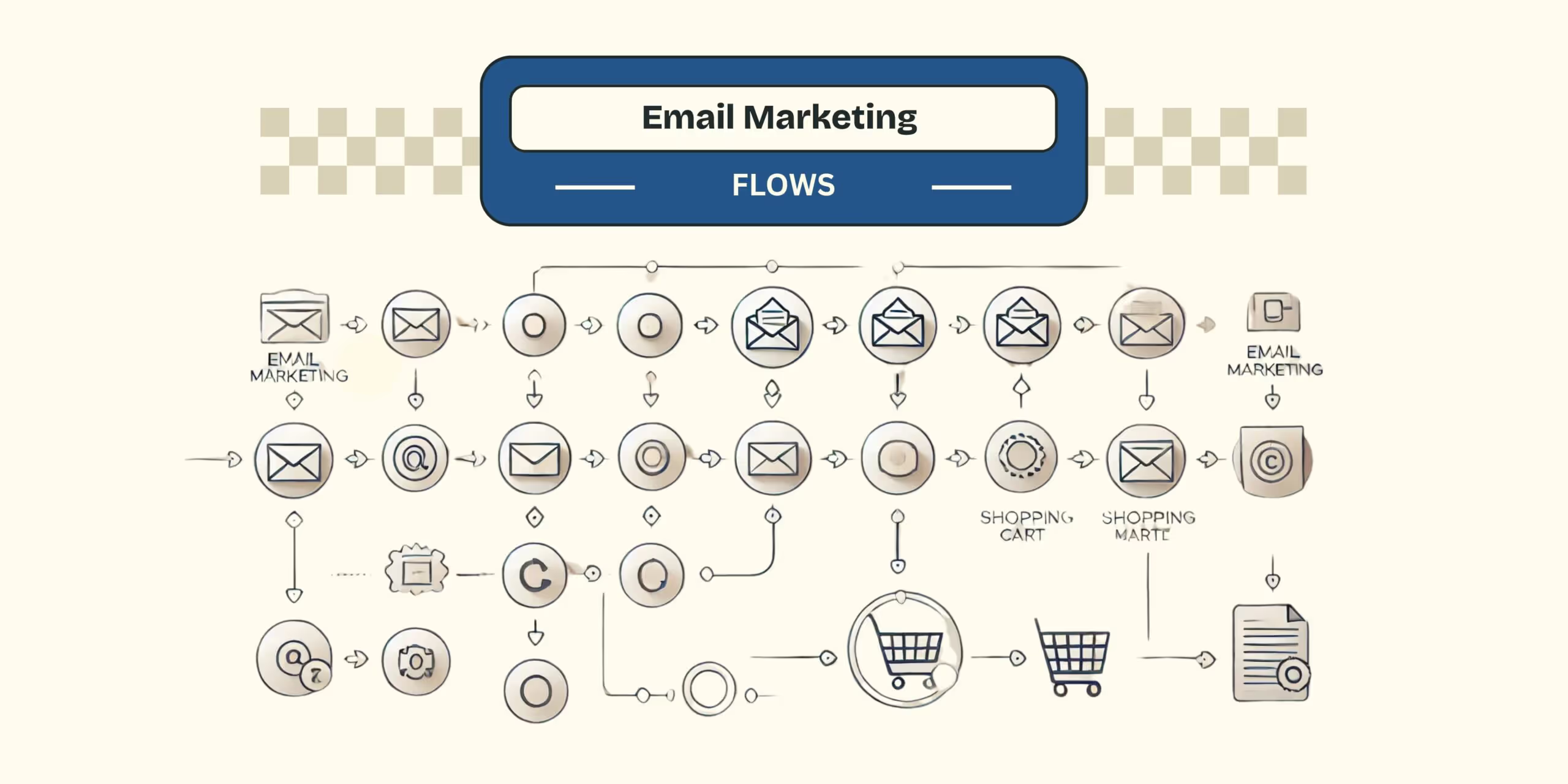
Core Email Marketing Flows: 2025 Essentials for Shopify

Top 5 Revenue-Generating Email Marketing Journeys (Straight from a Klaviyo Partner Agency)
The Long and the Short of It: Getting to “Yes” with Email Marketing
10 Email Marketing KPIs Every Marketer Needs to Know
3 Steps to Spring Clean Your Email Marketing Platform

How to Use Artificial Intelligence (AI) in Email Marketing in 2024

How To Create Marketing Emails That Engage Your Audience and Get Results


Not Sure Where to Start?
Let's find the biggest retention opportunities in your business. Get a free Klaviyo audit or retention consultation.