

TL;DR: Klaviyo's default attribution model credits email for purchases that may have happened anyway. The 5-day click window, open-based attribution, and email/SMS double-counting together mean most DTC brands are either significantly over-reporting or under-reporting email's true revenue contribution — and the fix starts with understanding exactly what Klaviyo is measuring.
Your CFO asks how much revenue email is driving. You pull the Klaviyo dashboard. The number looks great. Maybe a little too great.
That instinct is right. Klaviyo's default attribution model is built for simplicity, not precision. It's not wrong, exactly — it's just answering a different question than the one your CFO is asking. The dashboard number is "revenue attributed to email by Klaviyo's model." What your CFO wants is "revenue that wouldn't have happened without email." Those two numbers are rarely the same.
This article explains exactly what Klaviyo's model does, where it systematically overstates email's contribution, and how to get to a figure you can actually defend. No holdout test required.
How Does Klaviyo Attribute Revenue to Email Campaigns?
Klaviyo uses a last-click attribution model with a default 5-day click window and 1-day open window. Any purchase that occurs within 5 days of a recipient clicking an email — or within 1 day of opening one — gets credited to that email, regardless of what else influenced the purchase decision.
Last-click attribution is the methodology by which purchase credit is assigned to the final marketing touchpoint a customer interacted with before buying. In Klaviyo's implementation, a "click" touchpoint opens a 5-day attribution window, and an "open" touchpoint opens a 1-day window.
Here's what that means in practice. A customer opens your Monday campaign, clicks through to browse, doesn't buy. They see a retargeting ad on Wednesday, click it, add to cart, abandon. They come back on Thursday via Google search and purchase. Klaviyo attributes that order to Monday's email — because they clicked within the 5-day window. Google Analytics attributes it to organic search. Meta reports it as a retargeting conversion. Your total "attributed revenue" across channels now exceeds your actual revenue. This is the attribution overlap problem, and it's operating in your account right now.
To adjust your Klaviyo attribution window: go to Account → Settings → Attribution. You'll see separate controls for click and open windows. The defaults are 5-day click and 1-day open, but you can configure each independently. What you choose should reflect your brand's actual purchase cycle — which we'll cover in detail below.
For a deeper look at how attribution models compare across platforms, Google's documentation on attribution models provides a useful reference for understanding how last-click, first-click, and data-driven models differ in practice.
What Is the Default Attribution Window in Klaviyo?
Klaviyo's default is a 5-day click window and 1-day open window. This means email gets credit for any purchase within 5 days of an email click, or within 1 day of an open — even if the customer had multiple other touchpoints in that window, including paid ads, organic search, or direct site visits.
The 5-day window was designed for brands with medium-length consideration cycles. For a supplement brand with a familiar replenishment purchase, 5 days is arguably generous. For a home goods brand where customers research for two weeks before buying, a 5-day window captures almost nothing meaningful. Neither brand gets the right answer from the default.
The 1-day open window is where things get worse. Since Apple's Mail Privacy Protection (MPP) launched with iOS 15 in September 2021, Apple Mail pre-fetches email content and fires tracking pixels automatically — whether or not the recipient ever actually opens the email. Apple Mail typically represents a substantial share of most DTC email lists, with the exact proportion varying by brand audience and acquisition channels. This means a significant share of your "opens" are ghost opens generated by Apple's servers, not by human eyeballs. If you still have open-based attribution enabled, you're crediting email for purchases made by people who may have never seen your email.
Apple Mail Privacy Protection (MPP) is Apple's iOS 15 feature that pre-loads email content in the background, triggering open-tracking pixels before a subscriber ever reads the message — effectively making open rates unreliable for any list with substantial Apple Mail users.
The practical implication: open-based attribution in Klaviyo is broken for most DTC brands. Blossom disables it for all clients. The setting is worth checking in your account today.
Is Klaviyo Revenue Attribution Accurate?
Klaviyo attribution is internally consistent — it accurately reports what its model measures. The more important question is whether the model measures the right thing. For most DTC brands, Klaviyo's default settings overstate email's true revenue contribution, sometimes substantially, because they credit email for purchases that would have happened without it.
There are three specific mechanisms that inflate Klaviyo's reported numbers:
- Long attribution windows on short purchase cycles. A 5-day window on a brand where most replenishment purchases happen within 48 hours of the decision means email gets credit for purchases driven by habit, not by the email.
- Ghost opens from Apple MPP. If open attribution is enabled and a meaningful portion of your list uses Apple Mail, a large share of your "open-attributed" revenue is credited to emails that recipients may never have seen.
- Email/SMS double-counting. When a customer receives both an email and an SMS before purchasing, Klaviyo attributes the order to both channels. Your email-reported revenue and your SMS-reported revenue can overlap — and when you add them together, the total exceeds your actual retention revenue.
None of this means email isn't working. It means the dashboard number is a marketing number, not a business number. The CFO asking for email's true contribution needs something more defensible than Klaviyo's default output.
Key insight: The gap between Klaviyo's reported email revenue and email's true incremental contribution is widest for brands with active paid media, high Apple Mail penetration, and both email and SMS channels running simultaneously. If all three apply to your program, the gap can be substantial.
The Email/SMS Double-Counting Problem Most Brands Don't Know About
When a customer receives both an email and an SMS from your Klaviyo account before making a purchase, Klaviyo attributes that order to both channels — simultaneously. The same order appears in both your email revenue total and your SMS revenue total. For brands running both channels, total reported retention revenue can significantly exceed actual retention-driven revenue.
SMS attribution in Klaviyo operates under the same last-click logic as email attribution, with its own separate window. When both channels are active, both windows can be open at the same time for the same customer. If they click an email on Monday and click an SMS on Wednesday, then purchase on Thursday, both channels claim full credit.
Here's how to check whether this is inflating your numbers. In Klaviyo, look at your email-attributed revenue total for a given period, then look at your SMS-attributed revenue total for the same period. Now add them together. If that combined number exceeds your total revenue from all sources for that period — or is implausibly close to it — you have a double-counting problem.
The cleanest correction is to identify the "email-only" and "SMS-only" contribution by looking at which customers clicked email but not SMS (and vice versa) before purchasing. Most brands don't have an easy way to pull this in Klaviyo without exporting and cross-referencing, but it's the most accurate way to separate the channels.
A simpler heuristic: if your email-attributed revenue plus SMS-attributed revenue consistently totals more than results that vary by program above your total brand revenue, you're likely double-counting meaningfully. In our experience working with DTC programs across categories, this ratio is a reliable early warning signal — though the exact threshold varies by how aggressively both channels are deployed. The reported figures aren't wrong — they're just measuring overlapping windows, not additive contributions.
How Do I Measure the True Incremental Revenue from Email?
True incremental revenue from email is the revenue you would not have captured without sending the email — not just revenue that happened while an attribution window was open. Without a formal holdout test, you can estimate it using a three-step triangulation framework that gives you a defensible floor and ceiling for email's actual contribution.
Incremental revenue is the portion of attributed revenue that is causally driven by the marketing intervention — meaning purchases that would not have occurred without that specific email or campaign.
Here's the Attribution Sanity Check framework Blossom uses when a client needs a more defensible email revenue figure:
- Calculate your email-influenced purchase rate. Look at purchases where email was the only tracked digital touchpoint — no paid ad clicks, no branded search, just email click → purchase. This is your cleaner attribution subset. In Klaviyo, you can approximate this by filtering flow and campaign conversions and cross-referencing against customers who had paid media exposure (if you have that data in Shopify or a CDP). The resulting number is your high-confidence attribution floor.
- Apply an incrementality discount to the remaining attributed revenue. For the portion of attributed revenue that involved other touchpoints, apply a conservative discount based on your attribution window length. The logic: the longer the window, the more "coincidental" conversions it captures. A 1-day click window captures very few coincidental purchases; a 5-day window captures meaningfully more. In our experience, we typically apply a more modest discount to overlap revenue under a 1-day click window, and a steeper discount — often in the range of numbers that depend on your setup — under the 5-day default window. These are directional practitioner estimates based on Blossom's work with DTC programs, not universal benchmarks; the right discount for your brand will vary based on your purchase cycle length, traffic mix, and how much paid media is running concurrently.
- Compare adjusted figures against the raw Klaviyo number. Your raw Klaviyo number is your ceiling. Your email-only purchase subset is your floor. Your discounted figure is your best estimate of true incremental contribution. Present all three to your CFO with context: "Klaviyo reports X. Our conservative estimate of true incremental contribution is Y to Z." That range is a far more honest and defensible answer than a single dashboard number.
A holdout test is the gold standard — suppress a random sample of your list from a campaign, compare purchase rates between the holdout and send groups, and calculate the true lift. If you're running Klaviyo at scale, this is worth doing once per quarter on a major campaign. But the triangulation framework above gets you close enough for most planning and reporting purposes without the complexity.
For brands looking to understand holdout testing methodology more deeply, Harvard Business Review's primer on A/B testing and incrementality provides a practical foundation for understanding why controlled holdout tests remain the gold standard for measuring true causal lift.
What Attribution Settings Should I Actually Use in Klaviyo?
The right attribution settings depend on your brand's purchase cycle, channel mix, and how you plan to use the data. There is no universal correct configuration, but there are configurations that are clearly wrong for most DTC brands — and the default is one of them for any brand with meaningful Apple Mail penetration or active SMS.
Here's the decision framework Blossom applies when configuring attribution for DTC clients:
Attribution Window Decision Framework
- Open-based attribution: Disable it. Full stop, for any brand where Apple Mail represents a meaningful share of list volume. Ghost opens from MPP make this data unreliable and inflate your numbers in a way that's impossible to correct for retroactively. The setting lives at Account → Settings → Attribution → Conversion Attribution Windows.
- Click window — short purchase cycle (supplements, food, beauty refills, lower AOV categories): Set to 1-day click. Customers in these categories who are going to buy after clicking an email typically do so quickly. A 5-day window is capturing purchases driven by habit and intent that existed before the email arrived.
- Click window — medium purchase cycle (apparel, skincare, wellness, mid-range AOV): 1–2 day click window is defensible. The 5-day default is aggressive but not absurd. Consider 2-day as a reasonable middle ground that captures genuine consideration while reducing coincidental attribution.
- Click window — long purchase cycle (home goods, furniture, high-consideration items, higher AOV): Here the 5-day window may actually be too short. These customers research for days or weeks. A 5-day window misses legitimate email influence on purchases that closed after the window expired. Consider 7-day click for these categories — but pair it with stricter exclusion of customers who had paid media touchpoints in the same window.
- When both email and SMS are active: Accept that some double-counting is unavoidable with Klaviyo's current model. Report email and SMS revenue separately, never add them together and call the sum "retention revenue." Use the triangulation framework above to estimate the true combined retention contribution.
One practical note: changing your attribution settings in Klaviyo is not retroactive. Historical data stays attributed under the old settings. When you change the window, document the date — you'll need it to interpret performance trends correctly in the months that follow.
If you want to see how dramatically these settings affect the same email program, here's a worked example. Take a hypothetical DTC brand with a 30-day email analysis window. Based on Blossom's experience configuring attribution across DTC accounts, the directional pattern we typically observe looks like this:
- Klaviyo default (5-day click, 1-day open with MPP): Reported email revenue tends to land in the range of performance that shifts with your audience—performance that shifts with your audience of total revenue for brands with active paid media — often the highest figure you'll see from any settings configuration.
- Conservative (1-day click, no open attribution): Reported email revenue typically drops to figures that differ across accounts—figures that differ across accounts of total revenue — a meaningful reduction that reflects the removal of coincidental and ghost-open attribution.
- Incremental estimate (applying triangulation framework): Estimated true incremental contribution tends to fall somewhere in the range of outcomes tied to your specific list of total revenue after discounting for multi-touchpoint overlap.
These figures are directional practitioner estimates from Blossom's work with DTC programs, not universal benchmarks — your brand's numbers will vary based on purchase cycle, paid media spend, and list composition. The broader point is that the same email program, over the same 30 days, can report anywhere from the low teens to results that vary by program of total revenue depending on settings. Neither extreme is necessarily the "true" number. The 1-day click figure is probably too conservative (it misses legitimate purchases that took 2–3 days to close). The default figure is almost certainly too aggressive. The incremental estimate in the middle is the most defensible basis for business decisions.
How Does Klaviyo Attribution Differ Across Flows vs. Campaigns?
The same attribution model applies to both Klaviyo Flows and campaigns — but the practical implications differ significantly. Flow revenue tends to be more accurately attributed than campaign revenue because flows are triggered by specific purchase-intent behaviors, while campaigns are broadcast to engaged segments regardless of current purchase intent.
Klaviyo Flows are behavior-triggered automated sequences — welcome series, abandoned cart, post-purchase — that fire in response to a customer action. Revenue per recipient (RPR) is the average revenue generated per email sent in a flow, calculated by dividing total attributed flow revenue by the number of emails delivered.
When a cart abandonment flow fires, the customer has already demonstrated purchase intent by adding something to their cart. The email is responding to a real signal. Attribution here is tighter — the customer was already in a buying mindset, and the email's job is to remove friction and close the purchase. Cart abandonment flow revenue is among the most defensible email attribution in your account, according to Blossom's benchmark data, which shows 5–12% conversion rates for well-built flows against that specific intent signal.
Campaign attribution is murkier. A campaign broadcast to your engaged segment reaches customers at every stage of intent — some actively considering a purchase, some just in routine inbox-checking mode. When a campaign-attributed purchase occurs on day 4 of a 5-day window, the probability that the email causally drove that purchase is lower than for a cart abandonment email that fired 60 minutes after a customer abandoned checkout.
The practical takeaway: when analyzing your attribution data, give more weight to flow revenue figures than campaign revenue figures. If you're going to apply a skeptical discount to any portion of your Klaviyo-reported numbers, apply it more aggressively to campaign revenue and more lightly to high-intent flow revenue like cart and checkout abandonment.
For context on winback flows — where attribution gets especially murky — lapsed customers who re-engage are a particularly tricky attribution case. Some would have come back regardless; others were genuinely re-activated by the email. Winback flow revenue is worth treating with the same skepticism you'd apply to campaign revenue when building your incremental estimate.
How Long Should an Email Attribution Window Be?
Your attribution window should match your brand's actual purchase cycle — the typical time between first product consideration and completed purchase. A supplement brand with a low AOV and habitual buyers needs a different window than a home goods brand with a numbers that depend on your setup+ AOV and a two-week research process. The 5-day default serves neither well.
Purchase cycle is the typical elapsed time between a customer's initial consideration of a product and their completed purchase decision. It's the right anchor for attribution window calibration because it defines how long email influence on a purchase is plausible.
To find your brand's purchase cycle, pull the Shopify data for first-time buyers over the last 6 months. Look at the median time from first email click (which you can approximate from Klaviyo flow data) to first purchase. That number is your empirical benchmark for window length.
A few patterns from DTC verticals:
- Health and supplements: Replenishment cycles are predictable and purchase decisions are fast. Median click-to-purchase for new buyers tends to be short. A 1–2 day window captures most legitimate attribution.
- Beauty and skincare: Consideration periods are moderate. Customers compare, read reviews, sometimes wait for payday. A 2–3 day window is reasonable.
- Home goods and furniture: Customers research extensively before buying. A 5–7 day window is defensible here — but should be paired with UTM tracking to filter out purchases where paid media was the final touchpoint.
- Fashion and apparel: Variable by price point. Fast-fashion impulse buyers operate on 1-day cycles. Premium apparel buyers research for a week. Segment by AOV tier if you want precision.
The important principle: there is no attribution window that is simultaneously fair to email and precise for business decisions. Shorter windows undercount; longer windows overcount. The goal is a setting that minimizes systematic bias — and documenting your choice so that everyone reading the dashboard understands what it does and doesn't measure.
If your email segments vary significantly in purchase behavior — which they do, since VIP repeat buyers operate on different cycles than new subscribers — consider that your attribution window is a blunt instrument applied across very different purchase patterns. This is another reason why the triangulation framework produces a more nuanced picture than a single dashboard setting.
Conclusion: Your Klaviyo Number Is a Starting Point, Not an Answer
Klaviyo's attribution model is a tool. Like any tool, it produces output that reflects its design choices, not objective truth. The 5-day click window, the open-based attribution, the per-channel crediting that creates double-counting — these are pragmatic defaults built for simplicity. For most DTC brands, they overstate email's contribution to revenue, sometimes significantly.
That doesn't mean email isn't working. It means you need to interpret the dashboard with the model in mind.
The moves that matter:
- Disable open-based attribution if a meaningful share of your list is on Apple Mail
- Calibrate your click window to your brand's actual purchase cycle, not Klaviyo's default
- Never add email-attributed and SMS-attributed revenue together and call it your retention total
- Use the three-step triangulation framework when you need a defensible incremental estimate
- Give more weight to flow revenue attribution (intent-triggered) than campaign revenue attribution (broadcast)
- Document your attribution settings and the date you set them — so trend data stays interpretable
The brands that use this data well aren't the ones with the highest Klaviyo revenue numbers on the dashboard. They're the ones who understand what their number actually means — and can make decisions from it with confidence.
If RFM segmentation to identify your highest-value customers is already part of your analytics stack, layering it against your attribution analysis is the next step: understanding which customer tiers are most influenced by email (vs. those who would convert regardless) is the most actionable version of this problem.
academic research on incrementality measurement in digital marketing
Need help implementing this?
Let us take the hassle of managing your email marketing channel off your hands. Book a strategy call with our team today and see how we can scale your revenue, customer retention, and lifetime value with tailored strategies. Click here to get started.
Curious about how your Klaviyo is performing?
We’ll audit your account for free. Discover hidden opportunities to boost your revenue, and find out what you’re doing right and what could be done better. Click here to claim your free Klaviyo audit.
Want to see how we’ve helped brands just like yours scale?
Check out our case studies and see the impact for yourself. Click here to explore.

Read Our Other Blogs

Email Holdout Testing: How to Prove Your Retention Channel Is Actually Incremental



Klaviyo vs Omnisend: Which ESP Is Right for Your DTC Brand in 2026

Dedicated IP vs Shared IP for Ecommerce Email: When to Switch and When It Backfires

VIP Early Access Campaigns: How to Reward Best Customers Without Giving Anything Away

Gmail and Yahoo Bulk Sender Requirements: The Compliance Checklist Ecommerce Brands Can't Ignore

Spam Complaint Rate: Why 0.3% Is the Cliff Edge and How to Stay Far Below It

Klaviyo Custom Events: How to Track the Ecommerce Behaviors Shopify Doesn't Send by Default

Klaviyo vs Postscript: Choosing Your SMS Platform When You're Already on Klaviyo Email

Repeat Purchase Rate: The Diagnostic Framework for Finding Where Your Second Order Is Breaking Down

Apple Mail Privacy Protection: How to Measure Email Engagement When Opens Are Broken

Back-in-Stock Flow: The Highest-Intent Email Sequence Most Brands Never Build

Klaviyo Predictive Analytics: How to Use CLV, Churn Risk, and Expected Next Order Date to Drive Retention
Email Holdout Testing: How to Prove Your Retention Channel Is Actually Incremental
Klaviyo vs Omnisend: Which ESP Is Right for Your DTC Brand in 2026
Dedicated IP vs Shared IP for Ecommerce Email: When to Switch and When It Backfires

Quiz Funnels for Ecommerce: How to Grow Your List and Segment Subscribers Without Discounts

Klaviyo + Shopify Integration: The Complete Data Sync and Event Tracking Setup Guide

How to Repair Sender Reputation: The Recovery Playbook When Your Emails Land in Spam

Abandoned Cart Flow Strategy: Why Your Recovery Sequence Stops Working After Email One

Ecommerce Email Benchmarks: What Good Actually Looks Like for DTC Brands in 2026

Retention-Focused A/B Testing: What to Test in Email When You've Already Optimized the Basics

Klaviyo Segments vs Lists: How to Structure Your Audience Architecture for Scalable Retention

Email Deliverability for Ecommerce: The Complete Guide to Landing in the Inbox

Klaviyo List Hygiene: How to Clean Your Email List Without Killing Your Revenue

Sunset Flow: How to Win Back Unengaged Subscribers Before You Suppress Them

Welcome Flow Optimization: How to Turn New Subscribers Into First-Time Buyers Faster

Popup Strategy for Ecommerce: How to Grow Your List Without Training Customers to Wait for Discounts

Email Offer Architecture: How to Structure Promotions That Protect Margin and Still Convert

Klaviyo vs Attentive: Which Platform Is Right for Your DTC Stack in 2026

Migrating to Klaviyo: The Step-by-Step Playbook for Switching ESPs Without Losing Revenue

Browse Abandonment Flow: The Underbuilt Sequence Quietly Leaking Revenue

Post-Purchase SMS Flow: How to Use Text Messages to Build Loyalty After the First Order

Retention Marketing Dashboard: The Exact Metrics and Reports You Should Be Reviewing Weekly

Agency vs In-House Email Marketing: What Actually Moves the Needle for DTC Brands

SMS Marketing Strategy for Ecommerce: The Complete Guide

How to Set Up Klaviyo Flows: Complete Setup Guide

A/B Testing for Email: What to Test, How to Measure, When to Ship

Email Marketing KPIs: The Only Metrics That Matter for DTC

Popup Strategy for Ecommerce: 6 Types That Actually Convert

RFM Analysis for Ecommerce: Segment Your Customers by Value

Email Segmentation for Ecommerce: The 5-Layer Model for DTC Brands

Welcome Offer Optimization: Converting Subscribers Without Deep Discounts

Email Warmup Strategy: How to Build Sender Reputation From Scratch

Email List Hygiene: How to Clean Your List Without Killing Revenue

SPF, DKIM, and DMARC: Email Authentication Explained for DTC Brands

The Complete Retention Marketing Strategy Guide (2026)

Winback Flow: How to Re-Engage Lapsed Customers Before You Lose Them

How to Audit Your Email Flows (The 125-Point Checklist)

Post-Purchase Email Flow: The Architecture That Drives Repeat Buyers

Sunset Flow: When and How to Remove Unengaged Subscribers

Cart Abandonment Flow: How to Recover Revenue Without Discounting

How to Build a Welcome Flow That Actually Converts

How to Build an Email Campaign Calendar Without Discounting

Browse Abandonment Flow: Converting Window Shoppers Into Buyers

The Abandoned Cart Email Strategy That Actually Recovers Revenue

How to Build a Welcome Flow That Actually Converts

Personalizing Push Notifications for Better Retention Outcomes

How to Craft Email Newsletters That Build Real Brand Loyalty
Top 3 Best eCommerce Content Management Systems of 2025
Email Marketing vs. Social Media: Which One Should Your Brand Focus On?

Attract More Customers: Which Videos to Use in Your Email Marketing and Why
8 eCommerce Customer Service Mistakes You NEED to Stop Making (Like, Yesterday)
Creating The Perfect E-Commerce Tech Stack

Types of Content eCommerce Brands Need in Their Marketing Mix
Ecommerce Email Mistakes: Blossom Ecom Article on How to Stop Sending Bad Emails & Start Making More Money
Boost Your Bottom Line: The Ultimate Guide to Integrating Website and Email Strategies for Your eCommerce Business
6 Powerful Ecommerce Loyalty Program Examples (and How to Build Your Own)
Loyalty-First Guide to Customer Reactivation Email Campaigns
Using Email Marketing to Supercharge Your Loyalty Program

Unpacking Brand and Conversion in E-Commerce Design
13 Scary E-Commerce Mistakes (and How to Avoid Them)
How to Reduce Your E-Commerce Bounce Rate and Boost Engagement
Combining Content and Commerce for E-Commerce Success
Email Marketing Tips + Trends

E-Commerce Returns Analysis & Crafting a Profitable Returns Policy

9 Pro Tips for A/B Testing Emails with HubSpot
AI and Email Marketing: The Future is Here
How to Skyrocket Your Email Open Rates and Click-Through Rates
Email Isn’t Dead: 4 Reasons It’s Still a Digital Marketing Powerhouse

Email Marketing Series – #3: Building a Strong Email List
Email Marketing Series – #4: 9 Tips for Creating High-Impact Email CTAs

Email Marketing Series – #2: How to Craft Attention-Grabbing Subject Lines
Email Marketing vs. Social Media Marketing — Which Should I Use?
Email Marketing Series – #1: Crafting an Effective Email Marketing Strategy
Email Open Rate: A Practical Guide
3 Effective Strategies to Make Email Your Marketing Heavyweight Champion

How to Attract New Leads with Video in Your Email Marketing
How to Determine the Profitability of Your eCommerce Website
Multi-Channel eCommerce: The Key to Growing Your Online Business
Understanding eCommerce Conversion Rate & Optimization
How to Optimize Your eCommerce Website for More Conversions
Top 3 eCommerce and Digital Marketing Trends for 2025

Optimizing Your Email Marketing Strategy: A/B Testing Explained
35 Eye-Opening Email Marketing Stats You Need to Know
7 Email Marketing Tips to Boost Your SEO

11 Common Email Marketing Mistakes That Are Tanking Your Conversions (And How to Fix Them)
Strategic SEO Tips for Email Marketing: Boost Engagement and ROI
How to Measure and Increase Email Marketing ROI (Plus Templates That Convert!)

Do Lifecycle Email Campaigns Really Drive Conversions? Here’s What We Found
How to Use Remailing in Your Email Marketing Strategy

B2B Email Marketing: Building Relationships and Converting Leads
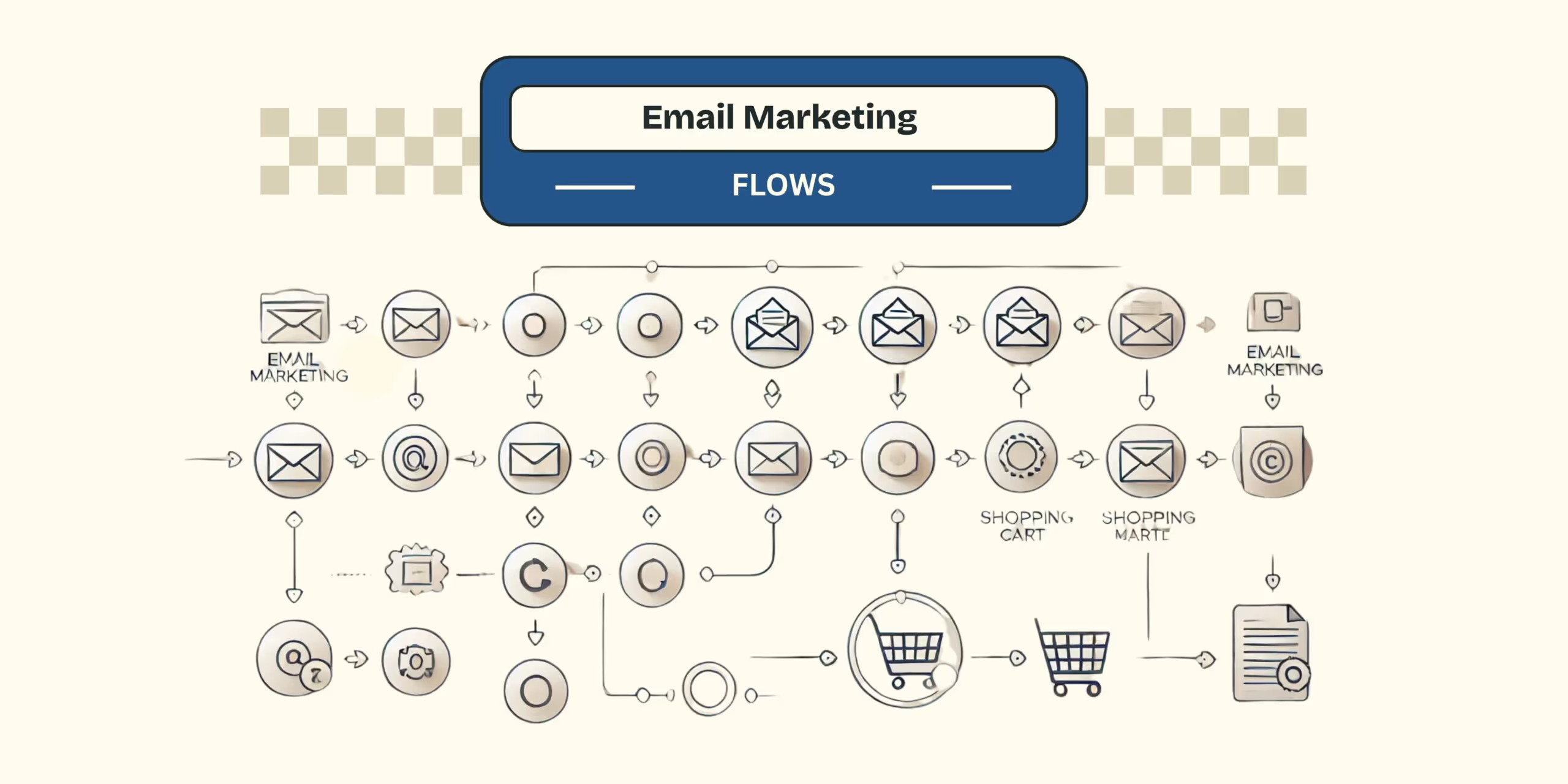
Core Email Marketing Flows: 2025 Essentials for Shopify

Top 5 Revenue-Generating Email Marketing Journeys (Straight from a Klaviyo Partner Agency)


Not Sure Where to Start?
Let's find the biggest retention opportunities in your business. Get a free Klaviyo audit or retention consultation.