

TL;DR: Most DTC brands on Klaviyo don't need to warm up an IP — they need to warm up their domain. Authentication comes first, volume ramp comes second, and warmup isn't finished until five specific metrics hit their thresholds. Here's the full playbook.
Every warmup guide on the first page of Google was written by a cold outreach tool trying to sell you a subscription. They're useful if you're a BDR sending prospecting sequences from a brand-new Outlook account. They're almost completely wrong if you're a DTC brand running Klaviyo.
The mechanics are different. The engagement benchmarks are different. The success criteria are different. And since February 2024, the prerequisites are different — Gmail and Yahoo now require DMARC alignment, a spam complaint rate under results that vary by program, and one-click unsubscribe before your warmup even starts to matter.
This guide gives you the actual DTC warmup playbook: a decision framework for shared vs. dedicated IP, a Klaviyo-specific ramp approach, and the five-metric scorecard that tells you when warmup is actually finished.
What Is Email Warmup — and Why Does It Work Differently for DTC?
Email warmup is the process of gradually increasing sending volume from a new domain or IP address so that Gmail, Yahoo, and Outlook learn to trust your sending behavior before you reach full volume. For DTC brands, this process is almost always about domain reputation — not IP reputation — and that distinction changes everything about how you execute it.
Klaviyo is an email and SMS marketing platform built for ecommerce brands, offering shared and dedicated IP infrastructure, flow automation, and engagement-based segmentation tools used throughout the warmup process described in this guide.
Sender reputation is the score that mailbox providers assign to your sending domain and IP address based on your sending history. It determines whether your emails land in the inbox, promotions tab, or spam folder. The signals that build it — engagement rates, complaint rates, bounce rates — are the same signals that warmup is designed to demonstrate.
Cold outreach senders are warming up individual inboxes or brand-new domains sending to strangers. DTC brands are warming up a domain reputation with an opted-in audience on a shared infrastructure. The process looks similar on the surface but operates on completely different logic underneath.
The DTC Warmup Decision: Do You Actually Need to Warm Up an IP?
Most DTC brands using Klaviyo are on a shared IP pool and don't need to warm up an IP at all. Klaviyo manages the IP reputation on shared pools. Your job is domain reputation — and that's a fundamentally different process with different tactics and different success criteria.
Shared IP pool is a group of IP addresses shared across multiple senders on a platform like Klaviyo, where the platform manages collective IP reputation so individual brands only need to build their own domain reputation.
Dedicated IP is a single IP address assigned exclusively to one sender, giving that sender full control — and full responsibility — for building and maintaining that IP's reputation with mailbox providers from scratch.
Here's how to figure out which situation you're in:
Branch 1: New Klaviyo Account on a Shared IP Pool
- Who this is: Any DTC brand sending under results that vary by program–500,000 emails per month on Klaviyo
- What warmup means: Domain reputation building only. Klaviyo manages the IP; you manage the sending behavior that builds your domain's track record with Gmail and Yahoo.
- The ramp: Start with your most engaged subscribers — recent purchasers, active openers, new signups in your welcome flow. Build outward over 3–4 weeks as your domain accumulates positive signals.
- Success metric: Domain reputation in Google Postmaster Tools moves to "High." Spam complaint rate stays under numbers that depend on your setup. Inbox placement rate stays above performance that shifts with your audience.
Branch 2: Migration to a Dedicated IP at Scale
- Who this is: Brands crossing Klaviyo's dedicated IP threshold, or brands specifically requesting a dedicated IP for their sending volume
- What warmup means: Both IP reputation AND domain reputation. The IP is brand new and has no history with any mailbox provider.
- The ramp: Much more structured. In our experience working with DTC brands through dedicated IP migrations, Week 1 typically starts at a conservative daily volume — often in the range of a few thousand emails per day — sent exclusively to 30-day engaged subscribers. Volume increases gradually each week as inbox placement and complaint rate metrics confirm the IP is building trust.
- Success metric: Same five-metric health scorecard as Branch 1, plus inbox placement testing confirms the IP specifically is landing in the inbox (not just the shared pool).
If you're in Branch 1 and you've been following dedicated-IP warmup advice, you've been doing unnecessary work. The IP isn't yours to warm — it's Klaviyo's. Your leverage is entirely in the engagement quality of what you send and who you send it to.
Authentication First: Why Warmup Is Actually Your Second Step
Warmup begins after authentication is verified. Starting your volume ramp without SPF, DKIM, and DMARC alignment means any complaint during warmup lands on a reputation that can't recover cleanly. The 2024 Gmail and Yahoo bulk sender requirements made this non-negotiable for anyone sending to more than 5,000 addresses per day.
Gmail bulk sender requirements (2024) is Google's mandatory policy requiring all senders of 5,000+ daily emails to maintain DMARC alignment, implement one-click List-Unsubscribe-Post headers, and keep spam complaint rates below defined thresholds — or face delivery failures. See Google's official bulk sender guidelines for the full technical specification.
Spam complaint rate is the percentage of delivered emails that recipients mark as spam, as reported by mailbox providers like Gmail through tools such as Google Postmaster Tools — the primary signal Google uses to evaluate whether a sender's mail should reach the inbox.
The February 2024 Gmail and Yahoo bulk sender requirements set a new minimum standard: DMARC alignment (not just a DMARC record — alignment between your From domain and your authenticated sending domain), one-click unsubscribe via the List-Unsubscribe-Post header, and a spam complaint rate below outcomes tied to your specific list sustained over time.
Klaviyo handles the List-Unsubscribe-Post header automatically, but the authentication setup is yours to configure. Before you send email 1 of your warmup sequence, verify all of these:
- SPF record is published on your sending subdomain (e.g.,
mail.yourbrand.com) and authorizes Klaviyo's sending servers - DKIM keys are configured — Klaviyo provides two CNAME records that sign every outgoing message cryptographically
- DMARC policy is published with at minimum
p=nonefor monitoring. You don't needp=rejectto start warmup, but you do need the record present and reporting active so you can catch misalignment before it becomes a deliverability problem - Google Postmaster Tools is set up for your sending domain. This is free, takes 10 minutes, and is the only tool that shows you Gmail's actual view of your domain reputation and complaint rate — the two most critical warmup metrics
- Your list is clean before you start sending. Hard bounces above results that vary by program during warmup signal to ISPs that your list quality is poor. Clean your list before warming your domain — this is a prerequisite, not an optional step.
Only after this checklist is complete do you begin the volume ramp. Set up SPF, DKIM, and DMARC before you send a single warmup email — getting it right the first time takes less effort than recovering from a spam placement that happened on a cracked authentication foundation.
For a deeper reference on DMARC configuration requirements, review the official DMARC.org implementation overview — it covers alignment modes and reporting setup that apply directly to the authentication steps above.
Key requirement: Google's 2024 bulk sender policy requires a spam complaint rate below numbers that depend on your setup — not as an average, but as a sustained threshold. A single campaign that spikes above performance that shifts with your audience during warmup is significantly harder to recover from than the same spike in a mature sending program. This is why warmup engagement segmentation matters so much.
How Do You Run the Warmup Volume Ramp for a DTC Brand?
The DTC warmup ramp starts with your highest-engagement subscribers and expands outward over 3–5 weeks. The ramp schedule is controlled by your engagement signals, not a fixed calendar — if complaint rate spikes or inbox placement drops, you pause and diagnose before continuing.
Engagement segmentation is the practice of sending only to your most engaged subscribers during the warmup period, then expanding to progressively less engaged segments as your domain builds a positive track record. It's the single highest-leverage tactic in any DTC warmup — because the quality of engagement signals you generate in the first two weeks determines how mailbox providers score everything you send afterward.
For DTC brands on Klaviyo, here's what the ramp looks like in practice:
Week 1 — Highly Engaged Core
- Who: Subscribers who purchased in the last 30 days + new welcome flow subscribers (last 7 days)
- Volume: A conservative starting volume — in our experience, DTC brands on shared IPs typically begin with their full highly engaged segment if it's small, or cap daily sends at a few hundred to a couple thousand while monitoring signals closely
- What to send: Your welcome flow is typically the first campaign you should send during warmup — new subscribers are the highest-engagement segment you have, open rates are strongest here, and the sends are expected
- Success threshold: Complaint rate under figures that differ across accounts, bounce rate under numbers that depend on your setup, no spam folder placements in seed tests
Week 2 — Expand to Recent Purchasers and 30-Day Openers
- Who: Add subscribers who opened or clicked in the last 30 days and purchased in the last 60 days
- Volume: Increase meaningfully over Week 1 daily volume — we typically see brands double or more their daily send count at this stage as positive signals accumulate
- What to send: Post-purchase flows, product education emails, social proof campaigns to recent buyers
- Success threshold: Same complaint and bounce rate floors. Check Google Postmaster Tools — domain reputation should show as Medium or High by end of Week 2
Week 3 — Expand to 60-Day Engaged Subscribers
- Who: Add subscribers who opened or clicked in the last 31–60 days
- Volume: Another strong increase, continuing to scale toward your regular campaign volume
- What to send: Campaign content: product-led, educational, social proof. Avoid aggressive promotional sends during this window — save those for after warmup is confirmed complete
Week 4–5 — Approach Full Volume
- Who: 90-day engaged subscribers. If 90-day is your full sendable list, this is your final step.
- Volume: Move toward your regular campaign volume
- What NOT to do: Do not add lapsed or unengaged subscribers during warmup. These contacts — anyone who hasn't engaged in 90+ days — are the fastest route to a complaint rate spike that damages the reputation you've spent weeks building. Save them for the winback flow after warmup is confirmed complete.
How Do You Know When Warmup Is Actually Finished?
Warmup is finished when five specific metrics hit their pass thresholds simultaneously — not after an arbitrary number of weeks. Most warmup guides tell you to ramp for 30 days and call it done. The data tells a different story, and ignoring it means you might be "done" before you're actually safe to send at full volume.
Here is the Post-Warmup Health Scorecard. All five metrics need to be passing before you expand to your full list and full campaign cadence:
Metric 1: Spam Complaint Rate
- Tool: Google Postmaster Tools (Gmail domain dashboard)
- Pass threshold: Below numbers that depend on your setup sustained over 7+ days at scale
- Warning threshold: performance that shifts with your audience–performance that shifts with your audience — investigate immediately. Review which segments are being sent to and whether any recent sends had misleading subject lines or confusing unsubscribe flows.
- Fail threshold: Above figures that differ across accounts — pause sending, diagnose root cause. This is the Gmail hard ceiling per the 2024 bulk sender requirements.
Metric 2: Inbox Placement Rate
- Tool: GlockApps or similar seed-testing tool (not Klaviyo's delivered rate — that only confirms server acceptance, not inbox placement)
- Pass threshold: Above outcomes tied to your specific list inbox placement across Gmail, Yahoo, and Outlook seed addresses
- Note: Inbox placement rate is the percentage of your emails that land in the primary inbox (not spam, not promotions tab) as measured against seed addresses. It is not the same as open rate, which is inflated by Apple Mail Privacy Protection for a significant portion of your list — in our client data, this tends to affect a substantial share of recorded opens, making click rate a more reliable engagement signal.
Metric 3: Domain Reputation (Gmail)
- Tool: Google Postmaster Tools — Domain Reputation dashboard
- Pass threshold: "High" rating
- Acceptable: "Medium" with upward trend
- Not ready: "Low" or "Bad" — warmup is not complete regardless of how many weeks have elapsed
Metric 4: Hard Bounce Rate
- Tool: Klaviyo campaign metrics
- Pass threshold: Below results that vary by program per send, sustained
- Note: Bounce rate measures the percentage of sent emails that fail to deliver. Hard bounces are permanent failures — invalid addresses — and carry more weight with ISPs than soft bounces (temporary failures like a full inbox). A hard bounce rate above numbers that depend on your setup during warmup is a list quality problem, not a warmup problem.
Metric 5: 30-Day Engagement Ratio
- Tool: Klaviyo — measure the click rate (not open rate) across the last 30 days of warmup sends
- Pass threshold: Click rate above performance that shifts with your audience sustained across your warmup sends. This signals that ISPs are seeing active engagement with your email, not passive delivery.
- Why click rate: Apple Mail Privacy Protection inflates open rates for a significant share of email opens — click rate is the engagement signal that remains accurate regardless of client behavior, and it's what we rely on in our own client warmup reviews.
When all five metrics are passing simultaneously for at least 7 days at your near-full send volume, warmup is complete. After that, you can begin the sends you were holding back: full campaign cadence, promotional sends, and — carefully, through the winback flow — re-engage your lapsed segment after warmup is complete.
What Happens If Warmup Stalls?
If complaint rate spikes, inbox placement drops, or domain reputation stalls at Medium during warmup, the correct move is to pull back volume, isolate the send that caused the problem, and diagnose before continuing — not push through hoping it resolves.
The three most common warmup failures in DTC programs and what to do about each:
Complaint Rate Spikes During Warmup
- Most likely cause: You expanded to a segment that wasn't ready. Subscribers who haven't engaged recently are more likely to hit "report spam" than unsubscribe, especially if they don't remember signing up.
- Fix: Pull back to your previous smaller, higher-engagement segment. Wait until complaint rate returns below figures that differ across accounts for 5+ days, then ramp again — more slowly this time.
Inbox Placement Drops to outcomes tied to your specific list on Gmail
- Most likely cause: Content issue or authentication gap. Gmail is more aggressive than Yahoo or Outlook on content filtering. Check your image-to-text ratio, link quality, and whether DMARC alignment is actually working (not just published).
- Fix: Run a mail-tester.com check on a test send. Verify DKIM signature is passing. Reduce image-heavy templates temporarily and shift to more text-based email while you diagnose.
Domain Reputation Stalls at Medium for 2+ Weeks
- Most likely cause: Not enough positive engagement signal accumulating. The emails are being delivered but subscribers aren't clicking, which doesn't give Gmail enough positive evidence to move the reputation score.
- Fix: For the next 1–2 weeks, send only to your most engaged subscribers (recent purchasers, new signups) with your highest-engagement content. Welcome flows and post-purchase flows typically have the strongest engagement and are ideal for this window.
Frequently Asked Questions
How long does email warmup take?
For most DTC brands on Klaviyo's shared IP pool, domain warmup takes 3–5 weeks when executed with proper engagement segmentation. Dedicated IP warmup takes 4–8 weeks depending on your monthly send volume and how quickly positive engagement signals accumulate. Warmup is finished when your five-metric health scorecard passes — not after an arbitrary timeline.
Do I need to warm up my email domain if I'm using Klaviyo?
Yes, but in a specific way. If you're on Klaviyo's shared IP pool (most DTC brands sending under 250,000–500,000 emails per month), you're warming your domain reputation, not an IP address. Klaviyo manages the IP. Your job is to demonstrate engagement quality to Gmail and Yahoo by starting with your most engaged subscribers and expanding gradually. Brands that skip this and blast their full list from a new domain frequently see inbox placement problems within the first two weeks.
What is the difference between IP warmup and domain warmup?
IP warmup applies when you're sending from a dedicated IP address that has no history with mailbox providers. Domain warmup applies to the reputation of your sending domain (e.g., mail.yourbrand.com) regardless of which IP it sends from. Most DTC brands on Klaviyo only need domain warmup, because Klaviyo's shared IP pools already have established reputations — the domain is what's new and needs to build trust.
What happens if you skip email warmup?
Sending full campaign volume from a new domain or IP without warming typically results in inbox placement dropping within the first 7–14 days as Gmail and Yahoo apply aggressive filtering to an unknown sender. Spam complaint rate tends to spike when the full list — including less-engaged subscribers — receives email before the domain has any reputation. Recovering from a damaged sender reputation takes significantly longer than a proper warmup would have taken in the first place.
Can I warm up my email domain manually without a tool?
Yes. For DTC brands, manual warmup through Klaviyo engagement segmentation is the standard approach — and it's more appropriate than cold-outreach warmup tools, which simulate reply behavior that doesn't apply to marketing email. The manual process is: verify authentication, start with your most engaged subscribers, expand outward weekly while monitoring your five-metric health scorecard in Google Postmaster Tools and Klaviyo.
Warmup is a discipline, not a tool subscription. Execute it with the right sequence — authentication first, engagement-segmented ramp second, health scorecard confirmation last — and your domain reputation will support everything you want to do with your list afterward.
Get tactics like this in your inbox every week. Subscribe to our newsletter →
Need help implementing this?
Let us take the hassle of managing your email marketing channel off your hands. Book a strategy call with our team today and see how we can scale your revenue, customer retention, and lifetime value with tailored strategies. Click here to get started.
Curious about how your Klaviyo is performing?
We’ll audit your account for free. Discover hidden opportunities to boost your revenue, and find out what you’re doing right and what could be done better. Click here to claim your free Klaviyo audit.
Want to see how we’ve helped brands just like yours scale?
Check out our case studies and see the impact for yourself. Click here to explore.

Read Our Other Blogs

Agency vs In-House Email Marketing: What Actually Moves the Needle for DTC Brands



SMS Marketing Strategy for Ecommerce: The Complete Guide

How to Set Up Klaviyo Flows: Complete Setup Guide

Browse Abandonment Flow: The Underbuilt Sequence Quietly Leaking Revenue

Post-Purchase SMS Flow: How to Use Text Messages to Build Loyalty After the First Order

Retention Marketing Dashboard: The Exact Metrics and Reports You Should Be Reviewing Weekly
Agency vs In-House Email Marketing: What Actually Moves the Needle for DTC Brands
SMS Marketing Strategy for Ecommerce: The Complete Guide
How to Set Up Klaviyo Flows: Complete Setup Guide

A/B Testing for Email: What to Test, How to Measure, When to Ship

Email Marketing KPIs: The Only Metrics That Matter for DTC

Email Revenue Attribution: What Klaviyo Gets Right and Wrong

Popup Strategy for Ecommerce: 6 Types That Actually Convert

RFM Analysis for Ecommerce: Segment Your Customers by Value

Email Segmentation for Ecommerce: The 5-Layer Model for DTC Brands

Welcome Offer Optimization: Converting Subscribers Without Deep Discounts

Email List Hygiene: How to Clean Your List Without Killing Revenue

SPF, DKIM, and DMARC: Email Authentication Explained for DTC Brands

The Complete Retention Marketing Strategy Guide (2026)

Winback Flow: How to Re-Engage Lapsed Customers Before You Lose Them

How to Audit Your Email Flows (The 125-Point Checklist)

Post-Purchase Email Flow: The Architecture That Drives Repeat Buyers

Sunset Flow: When and How to Remove Unengaged Subscribers

Cart Abandonment Flow: How to Recover Revenue Without Discounting

How to Build a Welcome Flow That Actually Converts

How to Build an Email Campaign Calendar Without Discounting

Browse Abandonment Flow: Converting Window Shoppers Into Buyers

The Abandoned Cart Email Strategy That Actually Recovers Revenue

How to Build a Welcome Flow That Actually Converts

Personalizing Push Notifications for Better Retention Outcomes

How to Craft Email Newsletters That Build Real Brand Loyalty
Top 3 Best eCommerce Content Management Systems of 2025
Email Marketing vs. Social Media: Which One Should Your Brand Focus On?

Attract More Customers: Which Videos to Use in Your Email Marketing and Why

8 eCommerce Customer Service Mistakes You NEED to Stop Making (Like, Yesterday)

Creating The Perfect E-Commerce Tech Stack

Types of Content eCommerce Brands Need in Their Marketing Mix
Ecommerce Email Mistakes: Blossom Ecom Article on How to Stop Sending Bad Emails & Start Making More Money

Boost Your Bottom Line: The Ultimate Guide to Integrating Website and Email Strategies for Your eCommerce Business

6 Powerful Ecommerce Loyalty Program Examples (and How to Build Your Own)
Loyalty-First Guide to Customer Reactivation Email Campaigns
Using Email Marketing to Supercharge Your Loyalty Program

Unpacking Brand and Conversion in E-Commerce Design
13 Scary E-Commerce Mistakes (and How to Avoid Them)

How to Reduce Your E-Commerce Bounce Rate and Boost Engagement

Combining Content and Commerce for E-Commerce Success

Email Marketing Tips + Trends

E-Commerce Returns Analysis & Crafting a Profitable Returns Policy

9 Pro Tips for A/B Testing Emails with HubSpot

AI and Email Marketing: The Future is Here

How to Skyrocket Your Email Open Rates and Click-Through Rates
Email Isn’t Dead: 4 Reasons It’s Still a Digital Marketing Powerhouse

Email Marketing Series – #3: Building a Strong Email List
Email Marketing Series – #4: 9 Tips for Creating High-Impact Email CTAs

Email Marketing Series – #2: How to Craft Attention-Grabbing Subject Lines
Email Marketing vs. Social Media Marketing — Which Should I Use?
Email Marketing Series – #1: Crafting an Effective Email Marketing Strategy
Email Open Rate: A Practical Guide

3 Effective Strategies to Make Email Your Marketing Heavyweight Champion

How to Attract New Leads with Video in Your Email Marketing
How to Determine the Profitability of Your eCommerce Website
Multi-Channel eCommerce: The Key to Growing Your Online Business
Understanding eCommerce Conversion Rate & Optimization
How to Optimize Your eCommerce Website for More Conversions
Top 3 eCommerce and Digital Marketing Trends for 2025

Optimizing Your Email Marketing Strategy: A/B Testing Explained
35 Eye-Opening Email Marketing Stats You Need to Know

7 Email Marketing Tips to Boost Your SEO

11 Common Email Marketing Mistakes That Are Tanking Your Conversions (And How to Fix Them)
Strategic SEO Tips for Email Marketing: Boost Engagement and ROI
How to Measure and Increase Email Marketing ROI (Plus Templates That Convert!)

Do Lifecycle Email Campaigns Really Drive Conversions? Here’s What We Found
How to Use Remailing in Your Email Marketing Strategy

B2B Email Marketing: Building Relationships and Converting Leads
Core Email Marketing Flows: 2025 Essentials for Shopify

Top 5 Revenue-Generating Email Marketing Journeys (Straight from a Klaviyo Partner Agency)

The Long and the Short of It: Getting to “Yes” with Email Marketing

10 Email Marketing KPIs Every Marketer Needs to Know
3 Steps to Spring Clean Your Email Marketing Platform

How to Use Artificial Intelligence (AI) in Email Marketing in 2024

How To Create Marketing Emails That Engage Your Audience and Get Results

Why SMS is the Perfect Addition to Any Marketing Mix

Why Personalization is Critical for eCommerce Growth

How to Grow Your Startup’s Email List: Lessons from Daycation

How We Achieved a 27% Winback Rate with a Smart Email Strategy for Dumpling
The Hidden Pitfalls of Email Marketing: Blacklists and Spam Traps
The iOS18 Mail Update: What Marketers Need to Know

Supercharging Customer Journey Automations with Email Touchpoints
Why Your Abandoned Cart Series Needs More Than One Email
13 Simple Design Hacks Using Klaviyo Email Marketing & Shopify
5 Simple Tactics to Grow Your Klaviyo SMS List Without Overcomplicating Things

Why Klaviyo SMS Crushes Other SMS Providers (And How Ignoring It Costs You Revenue)

10 Klaviyo Strategies That Drove Over $50 Million for Our Clients

Email Marketing Management for eCommerce: A Real Guide
Email Marketing 101: How to Create Emails That Convert

Shopify Email Marketing: Campaigns + Automations That Actually Grow Sales
7 eCommerce Trends to Watch in 2025
The Complete Guide to Winning at B2B eCommerce in 2025

Answering YOUR Email Marketing Questions

What Is Email Marketing and Why Does It Work So Well?
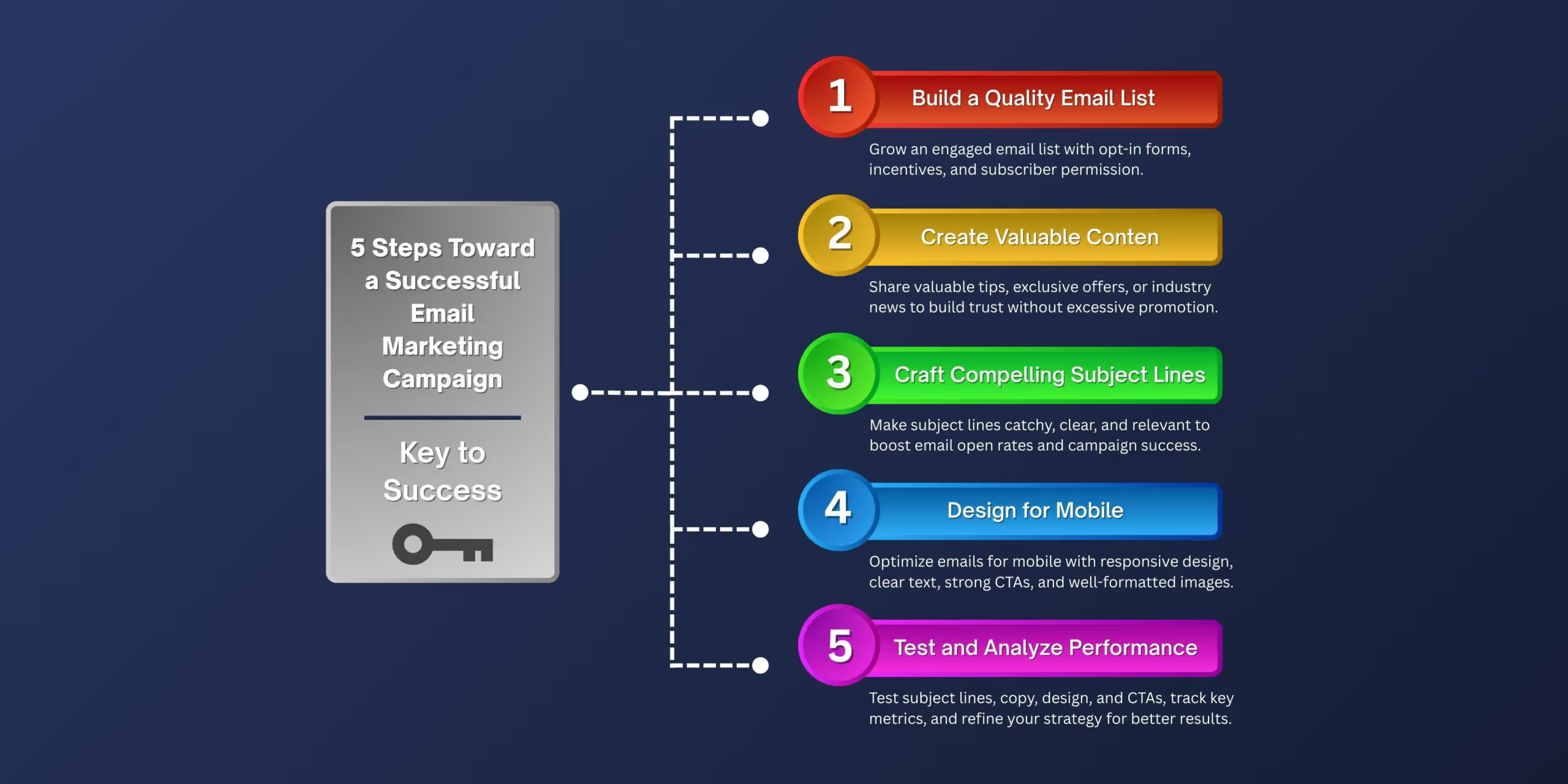
5 Steps Toward a Successful Email Marketing Campaign

8 Proven Strategies to Build Your Email Marketing Lists in 2025

How to Supercharge Your Social Media with Email Marketing


Not Sure Where to Start?
Let's find the biggest retention opportunities in your business. Get a free Klaviyo audit or retention consultation.