
Free Gift With Purchase vs Discount: Which Offer Protects Margin and Still Converts

Last updated: October 2026
A gift with purchase often protects more margin per conversion than a percentage-off discount — and the advantage compounds as average order value increases. Your gift cost is fixed at COGS, while a discount scales with every dollar the customer spends. The question is not which offer type is universally better. It is which one costs you less per conversion in your specific margin structure.
Most brands default to percentage-off because it is the fastest lever to pull. But that speed has a cost: every discount is a direct revenue haircut that grows linearly with order value. Gift with purchase (GWP) is a promotional strategy where the customer receives a free item when they make a qualifying purchase — and it flips the incentive math by decoupling your cost from the customer's cart total.
This is the tactical companion to our broader guide on structuring promotions that protect margin. Below: the margin math framework to make the decision, the A/B test blueprint to prove it in Klaviyo, and the tiered GWP flow architecture that eliminates manual fulfillment.
Why Does Gift With Purchase Cost Less Per Conversion Than a Discount?
GWP exploits the gap between what an item costs you to produce and what a customer perceives it to be worth at retail. A deluxe sample with a cost of goods around $3–5 can carry a perceived retail value of $20–30 — delivering the emotional impact of a significant incentive while your actual per-order expense stays flat regardless of cart size.
Perceived value is what the customer believes an item is worth based on its retail positioning, packaging, and presentation context — independent of what it actually costs to manufacture.
A percentage-off discount is a linear function of order value. The more the customer spends, the more margin you surrender. At 15% off, your cost is $7.50 on a strong order, $15 on a healthy order, and $30 on a solid order. The discount scales with the cart. The gift does not.
Cost of goods sold (COGS) is the direct cost to produce or acquire one unit of a product — materials, manufacturing, packaging, and freight to your warehouse.
That $4 sample costs $4 whether the customer's cart is $50 or $500. This is why the margin advantage of GWP compounds at higher average order value (AOV) — the spread between your fixed gift cost and the scaling discount cost widens with every dollar the customer adds to the cart.
There is a psychological layer too. A tangible gift feels like receiving something. A discount feels like paying less. In our experience with DTC clients, that receiving frame tends to generate stronger brand association and post-purchase recall — the customer remembers the gift long after they have forgotten the percentage.
How Do You Calculate the Real Cost of GWP vs Discount?
Run the same comparison at three price points using your actual product COGS and your planned discount percentage. Discount cost equals AOV multiplied by the discount rate. GWP cost equals the landed COGS of the gift item. The difference between those two numbers — multiplied by your monthly flow conversions — is the margin you either recover or leave on the table.
Contribution margin is revenue minus variable costs (COGS, shipping, payment processing) — the profit each order contributes before fixed overhead. It is the number that actually matters when comparing offer strategies, because it accounts for the real cost of each incentive type against what each order earns.
Here is the framework. We are using a 15% discount against a gift item with $4 landed COGS and roughly $25 in perceived value — a realistic ratio for deluxe samples, travel-size products, or branded accessories in most DTC categories.
At competitive Average Order Value
- 15% discount cost: $12.00 in lost revenue per order
- GWP cost (deluxe sample): $4.00 per order
- Margin recovered with GWP: $8.00 per conversion
At meaningful Average Order Value
- 15% discount cost: $18.00 in lost revenue per order
- GWP cost (same sample): $4.00 per order
- Margin recovered with GWP: $14.00 per conversion
At strong Average Order Value
- 15% discount cost: $30.00 in lost revenue per order
- GWP cost (same sample): $4.00 per order
- Margin recovered with GWP: $26.00 per conversion
The formula for your own products: Margin advantage per conversion = (AOV × discount rate) − gift COGS. If that number is positive, GWP protects more margin. Plug in your actual AOV and your gift item's landed COGS to run this for your catalog. At 500 conversions per month, even an $8 per-conversion difference translates to $4,000 in recovered margin monthly.
The pattern is clear: the discount's cost scales with order value while the gift's cost stays flat. The higher your AOV, the stronger the structural case for GWP.
What Makes a High-Leverage Gift With Purchase?
The strongest GWP items score high on four criteria: a wide gap between COGS and perceived value, clear relevance to the primary purchase, potential to convert the customer to a full-size purchase later, and minimal fulfillment complexity. Getting even one of these wrong — especially fulfillment — can erase the margin advantage you just calculated.
Not every gift is worth offering. A generic branded tote bag might cost $3 but carries almost no perceived value for most DTC audiences. A deluxe sample of your next-best product costs about the same and feels like a $20–25 value because the customer can see exactly what they would pay for it at full size.
The Four Gift Selection Criteria
- COGS-to-perceived-value ratio: Target a multiple of at least four. A $4 item that looks and feels like $20+ retail value is the sweet spot. Below a 3x ratio, the fulfillment overhead rarely justifies the approach.
- Relevance to the core purchase: The gift should complement what the customer is already buying, not compete with it. A skincare brand gifting a serum sample with a moisturizer purchase makes sense. Gifting a sticker sheet does not.
- Sample-to-full-size conversion potential: The best GWP items create a future sale. A deluxe sample that performs well earns a full-size reorder — turning one incentive cost into two purchases.
- Fulfillment complexity: Can it ship in the same package and auto-add to the order at checkout? If the gift requires separate picking, custom packaging inserts, or manual order edits, the operational cost erodes your margin advantage.
For VIP and repeat-purchase segments, exclusivity and early access often outperform physical gifts entirely. Access costs zero in COGS and carries high perceived value for your best customers — a useful reminder that GWP is not the only non-discount incentive in the playbook.
How Do You A/B Test GWP Against a Discount in Klaviyo?
Split your flow into two paths using a random sample, send one group a percentage-off offer and the other a GWP offer with equivalent perceived value, and measure margin-adjusted revenue per recipient — not raw conversion rate. A discount path might convert higher but generate less profit per recipient once you subtract each path’s incentive cost.
Revenue per recipient (RPR) is the average revenue generated per email delivered in a flow, calculated by dividing total flow revenue by total emails sent. It is the standard Klaviyo performance metric for flows — but for this test, standard RPR is not enough.
Standard RPR does not account for the cost of the incentive itself. A 20% discount path that converts slightly higher might look like it wins — until you subtract the discount's revenue cost from that path and the gift's COGS from the other. The metric you need is margin-adjusted RPR: path revenue minus total incentive cost, divided by recipients.
- Choose your test flow — welcome or cart abandonment gives you the highest volume and fastest path to statistical significance
- Create a 50/50 random split at the flow entry point in Klaviyo
- Build Path A with your discount offer — keep the email structure, cadence, and design identical to Path B
- Build Path B with your GWP offer — same structure, different incentive
- Match perceived value between paths (a $4 COGS gift positioned at $25 retail pairs well against 15% off at $80–120 AOV)
- Run for a minimum of 30 days or until both paths reach at least 1,000 recipients — use a sample size calculator to validate your minimum based on expected conversion rate difference
- Calculate margin-adjusted RPR for both paths: (path revenue − total incentive cost) ÷ path recipients
- Check conversion rate AND AOV separately — GWP paths frequently show slightly lower conversion rate but higher AOV, which can be a net margin win
For a deeper framework on what to test in your retention program and how to structure tests that compound over time, start there before running this comparison.
How Do You Set Up a Tiered GWP Flow in Klaviyo?
A tiered GWP system uses conditional splits in Klaviyo to check cart value and route customers to the appropriate gift tier. Combined with Shopify automatic discounts to auto-add the gift at checkout, this eliminates manual fulfillment — letting you run a three-tier program where higher spend unlocks better gifts without anyone touching an order.
The biggest objection to GWP is operations: who adds the gift to the order? The answer is nobody, if you wire it correctly.
A conditional split is a Klaviyo flow action that routes profiles down different paths based on event data, profile properties, or segment membership — letting you show different email content to different customers within the same automation.
- Set your flow trigger (Started Checkout works well — the customer has committed enough that the gift tier is relevant to their decision)
- Add a conditional split checking the cart total against your tier thresholds (e.g., under $75 / $75–124 / $125 and above)
- Build a separate email branch for each tier, showing that tier's specific gift with its retail value prominently displayed
- In Shopify, configure an automatic discount for each tier that auto-adds the free gift item when the cart hits the threshold — no coupon code needed
- Use dynamic content blocks in each email branch to swap the gift image and name per tier without building entirely separate flows
- Add a conditional split after each email checking for a Placed Order event — if the customer purchased, exit the flow
Each email branch should highlight the gift's retail value front and center: "You have unlocked a FREE [Product Name] — a $25 value — with your order." The perceived value callout is what makes the incentive feel generous.
If you are newer to building flows in Klaviyo, start with a single-tier GWP — one gift at one threshold — before adding conditional tiers. A single tier captures the core margin advantage and is simpler to maintain while you validate the approach with your audience.
When Should You Use a Discount Instead of a Gift With Purchase?
Discount wins in four specific scenarios: clearing end-of-season inventory where unit reduction matters more than margin, product categories with no logical gift complement, pure acquisition plays where the brand accepts first-order loss to capture customer lifetime value, and low-AOV products where even a modest percentage off costs less than the landed COGS of any viable gift.
GWP is not universally superior. Here are the scenarios where we consistently see discounts perform better for DTC brands:
- Clearance and liquidation: The goal is moving units fast, not protecting margin. A straight percentage off communicates "deal" faster and more directly than a gift ever will.
- No natural gift complement: Some product categories — industrial tools, replacement parts, single-SKU brands with no adjacent products — have no logical gift item. Forcing a gift where none fits feels hollow to the customer.
- Acquisition-first economics: When the brand has modeled that customer lifetime value (CLV) justifies a loss on order one, simplicity wins. A new subscriber who does not yet know the brand may respond better to a clear percentage off than a gift they cannot evaluate.
- Low AOV (under $50): When your AOV is low enough that a 15% discount costs $7.50 and your cheapest viable gift has $6 or more in landed COGS, the discount is cheaper and simpler to execute.
For welcome offer optimization specifically, test both approaches. Welcome flows are your highest-volume conversion point, which means they give you the fastest path to statistical significance on this exact question — and the answer may surprise you.
The honest framework: run the margin math from the comparison above, test it with the A/B blueprint, and let the numbers decide for your brand. The answer is not always GWP. But above $80 AOV with a viable gift item, the math usually favors it.
Build the Math First, Then Build the Flow
GWP wins when your AOV exceeds $80, your gift item has a COGS-to-perceived-value ratio of at least four-to-one, and you can automate fulfillment through Shopify. Discounts win for clearance, pure acquisition, low-AOV products, and categories with no logical gift complement. The margin math formula and A/B test blueprint above give you the numbers to decide for your brand.
The default instinct in DTC is to reach for the discount lever because it is fast. And sometimes fast is correct — clearance, pure acquisition, low AOV.
But for brands running $80-plus AOV with products that have logical gift complements, GWP offers a structural margin advantage that compounds with every conversion. When your gift costs $4 and your discount costs $12–30 per order, the savings stack quickly — and they stack quietly, because the customer's experience of the incentive feels equally generous.
Three pieces make this work: the margin math to know which offer wins for your specific products, the A/B test architecture to prove it with your specific audience, and the Klaviyo flow setup to automate tiered GWP without creating an operations burden. The next step is plugging in your own numbers.
Frequently Asked Questions
Below are the most common questions brands ask when evaluating gift with purchase against percentage-off discounts — covering when each incentive type wins on margin, how to set up automated GWP in Shopify and Klaviyo without manual fulfillment, and what criteria define a high-performing gift item.
Is a free gift with purchase better than a discount?
In most cases where AOV exceeds $80 and a viable gift item exists with a strong COGS-to-perceived-value ratio, yes — GWP protects more margin per conversion. The core advantage is structural: your gift cost is fixed at COGS while a discount cost scales linearly with order value. Run the margin math formula (AOV × discount rate minus gift COGS) with your own numbers to confirm for your product line. When the result is positive, GWP is the stronger margin play.
Do gift with purchase offers increase average order value?
Tiered GWP structures tend to lift AOV because they give customers a concrete spending target to reach. When the email communicates "spend $125 to unlock a free full-size product," customers who are close to the threshold frequently add items to qualify. A flat percentage-off discount rewards whatever is already in the cart without creating a reason to add more. The AOV lift is one reason GWP paths can win on margin-adjusted RPR even when their raw conversion rate is slightly lower.
How do you set up gift with purchase in Shopify without manual fulfillment?
Use Shopify's automatic discount feature configured to auto-add a free gift item when the cart reaches your spend threshold. No coupon code is needed and no manual order edits are required — the gift appears in the customer's cart at checkout automatically. On the Klaviyo side, use conditional splits in your flow to check cart value and show the appropriate gift tier in the email content. The two systems work together: Klaviyo tells the customer what they have unlocked, and Shopify adds it at checkout.
What is a good gift with purchase for ecommerce?
The strongest GWP items have a COGS-to-perceived-value ratio of at least four-to-one and are clearly relevant to the customer's primary purchase. Deluxe samples, travel sizes, limited-edition color variants, and branded accessories that enhance product usage all work well. Avoid generic items like stickers, keychains, or tote bags that carry low perceived value relative to their cost. The best gifts also create a future sale — a deluxe sample that impresses earns a full-size reorder.
When should you use a discount instead of a gift with purchase?
Use discounts when clearing end-of-season inventory where moving units matters more than margin, when no logical gift exists for your product category, when running acquisition plays where first-order loss is acceptable to capture long-term customer value, or when your AOV is low enough that even a modest percentage off costs less than any viable gift's landed COGS. Below $50 AOV, discounts are often the more cost-effective and operationally simpler incentive to execute.
Get tactics like this in your inbox every week. Subscribe to our newsletter →
Need help implementing this?
Let us take the hassle of managing your email marketing channel off your hands. Book a strategy call with our team today and see how we can scale your revenue, customer retention, and lifetime value with tailored strategies. Click here to get started.
Curious about how your Klaviyo is performing?
We’ll audit your account for free. Discover hidden opportunities to boost your revenue, and find out what you’re doing right and what could be done better. Click here to claim your free Klaviyo audit.
Want to see how we’ve helped brands just like yours scale?
Check out our case studies and see the impact for yourself. Click here to explore.

Read Our Other Blogs

Browse Abandonment Flow: The Underbuilt Sequence Quietly Leaking Revenue



Post-Purchase SMS Flow: How to Use Text Messages to Build Loyalty After the First Order

Retention Marketing Dashboard: The Exact Metrics and Reports You Should Be Reviewing Weekly

VIP Early Access Campaigns: How to Reward Best Customers Without Giving Anything Away

Gmail and Yahoo Bulk Sender Requirements: The Compliance Checklist Ecommerce Brands Can't Ignore

Spam Complaint Rate: Why 0.3% Is the Cliff Edge and How to Stay Far Below It

Klaviyo Custom Events: How to Track the Ecommerce Behaviors Shopify Doesn't Send by Default

Klaviyo vs Postscript: Choosing Your SMS Platform When You're Already on Klaviyo Email

Repeat Purchase Rate: The Diagnostic Framework for Finding Where Your Second Order Is Breaking Down

Apple Mail Privacy Protection: How to Measure Email Engagement When Opens Are Broken

Back-in-Stock Flow: The Highest-Intent Email Sequence Most Brands Never Build

Klaviyo Predictive Analytics: How to Use CLV, Churn Risk, and Expected Next Order Date to Drive Retention

Email Holdout Testing: How to Prove Your Retention Channel Is Actually Incremental

Klaviyo vs Omnisend: Which ESP Is Right for Your DTC Brand in 2026

Dedicated IP vs Shared IP for Ecommerce Email: When to Switch and When It Backfires

Quiz Funnels for Ecommerce: How to Grow Your List and Segment Subscribers Without Discounts

Klaviyo + Shopify Integration: The Complete Data Sync and Event Tracking Setup Guide

How to Repair Sender Reputation: The Recovery Playbook When Your Emails Land in Spam

Abandoned Cart Flow Strategy: Why Your Recovery Sequence Stops Working After Email One

Ecommerce Email Benchmarks: What Good Actually Looks Like for DTC Brands in 2026

Retention-Focused A/B Testing: What to Test in Email When You've Already Optimized the Basics

Klaviyo Segments vs Lists: How to Structure Your Audience Architecture for Scalable Retention

Email Deliverability for Ecommerce: The Complete Guide to Landing in the Inbox

Klaviyo List Hygiene: How to Clean Your Email List Without Killing Your Revenue

Sunset Flow: How to Win Back Unengaged Subscribers Before You Suppress Them

Welcome Flow Optimization: How to Turn New Subscribers Into First-Time Buyers Faster

Popup Strategy for Ecommerce: How to Grow Your List Without Training Customers to Wait for Discounts

Email Offer Architecture: How to Structure Promotions That Protect Margin and Still Convert

Klaviyo vs Attentive: Which Platform Is Right for Your DTC Stack in 2026

Migrating to Klaviyo: The Step-by-Step Playbook for Switching ESPs Without Losing Revenue
Browse Abandonment Flow: The Underbuilt Sequence Quietly Leaking Revenue
Post-Purchase SMS Flow: How to Use Text Messages to Build Loyalty After the First Order
Retention Marketing Dashboard: The Exact Metrics and Reports You Should Be Reviewing Weekly

Agency vs In-House Email Marketing: What Actually Moves the Needle for DTC Brands

SMS Marketing Strategy for Ecommerce: The Complete Guide

How to Set Up Klaviyo Flows: Complete Setup Guide

A/B Testing for Email: What to Test, How to Measure, When to Ship

Email Marketing KPIs: The Only Metrics That Matter for DTC

Email Revenue Attribution: What Klaviyo Gets Right and Wrong

Popup Strategy for Ecommerce: 6 Types That Actually Convert

RFM Analysis for Ecommerce: Segment Your Customers by Value

Email Segmentation for Ecommerce: The 5-Layer Model for DTC Brands

Welcome Offer Optimization: Converting Subscribers Without Deep Discounts

Email Warmup Strategy: How to Build Sender Reputation From Scratch

Email List Hygiene: How to Clean Your List Without Killing Revenue

SPF, DKIM, and DMARC: Email Authentication Explained for DTC Brands

The Complete Retention Marketing Strategy Guide (2026)

Winback Flow: How to Re-Engage Lapsed Customers Before You Lose Them

How to Audit Your Email Flows (The 125-Point Checklist)

Post-Purchase Email Flow: The Architecture That Drives Repeat Buyers

Sunset Flow: When and How to Remove Unengaged Subscribers

Cart Abandonment Flow: How to Recover Revenue Without Discounting

How to Build a Welcome Flow That Actually Converts

How to Build an Email Campaign Calendar Without Discounting

Browse Abandonment Flow: Converting Window Shoppers Into Buyers

The Abandoned Cart Email Strategy That Actually Recovers Revenue

How to Build a Welcome Flow That Actually Converts

Personalizing Push Notifications for Better Retention Outcomes
How to Craft Email Newsletters That Build Real Brand Loyalty
Top 3 Best eCommerce Content Management Systems of 2025
Email Marketing vs. Social Media: Which One Should Your Brand Focus On?
Attract More Customers: Which Videos to Use in Your Email Marketing and Why
8 eCommerce Customer Service Mistakes You NEED to Stop Making (Like, Yesterday)
Creating The Perfect E-Commerce Tech Stack

Types of Content eCommerce Brands Need in Their Marketing Mix
Ecommerce Email Mistakes: Blossom Ecom Article on How to Stop Sending Bad Emails & Start Making More Money
Boost Your Bottom Line: The Ultimate Guide to Integrating Website and Email Strategies for Your eCommerce Business
6 Powerful Ecommerce Loyalty Program Examples (and How to Build Your Own)
Loyalty-First Guide to Customer Reactivation Email Campaigns
Using Email Marketing to Supercharge Your Loyalty Program
Unpacking Brand and Conversion in E-Commerce Design
13 Scary E-Commerce Mistakes (and How to Avoid Them)
How to Reduce Your E-Commerce Bounce Rate and Boost Engagement
Combining Content and Commerce for E-Commerce Success
Email Marketing Tips + Trends

E-Commerce Returns Analysis & Crafting a Profitable Returns Policy

9 Pro Tips for A/B Testing Emails with HubSpot
AI and Email Marketing: The Future is Here
How to Skyrocket Your Email Open Rates and Click-Through Rates
Email Isn’t Dead: 4 Reasons It’s Still a Digital Marketing Powerhouse

Email Marketing Series – #3: Building a Strong Email List
Email Marketing Series – #4: 9 Tips for Creating High-Impact Email CTAs

Email Marketing Series – #2: How to Craft Attention-Grabbing Subject Lines
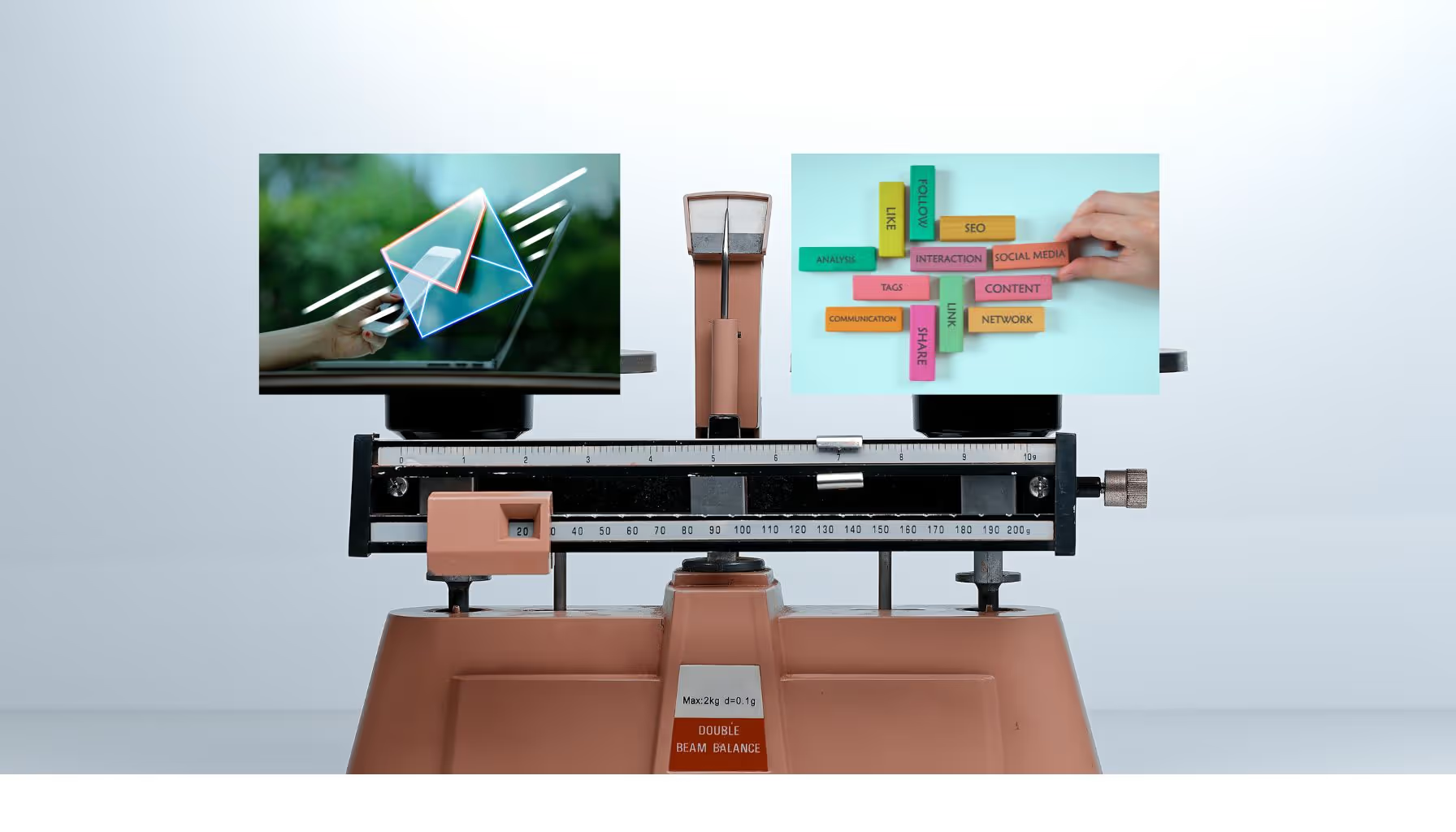
Email Marketing vs. Social Media Marketing — Which Should I Use?
Email Marketing Series – #1: Crafting an Effective Email Marketing Strategy
Email Open Rate: A Practical Guide
3 Effective Strategies to Make Email Your Marketing Heavyweight Champion

How to Attract New Leads with Video in Your Email Marketing
How to Determine the Profitability of Your eCommerce Website
Multi-Channel eCommerce: The Key to Growing Your Online Business
Understanding eCommerce Conversion Rate & Optimization
How to Optimize Your eCommerce Website for More Conversions
Top 3 eCommerce and Digital Marketing Trends for 2025

Optimizing Your Email Marketing Strategy: A/B Testing Explained
35 Eye-Opening Email Marketing Stats You Need to Know
7 Email Marketing Tips to Boost Your SEO
11 Common Email Marketing Mistakes That Are Tanking Your Conversions (And How to Fix Them)
Strategic SEO Tips for Email Marketing: Boost Engagement and ROI
How to Measure and Increase Email Marketing ROI (Plus Templates That Convert!)

Do Lifecycle Email Campaigns Really Drive Conversions? Here’s What We Found
How to Use Remailing in Your Email Marketing Strategy

B2B Email Marketing: Building Relationships and Converting Leads
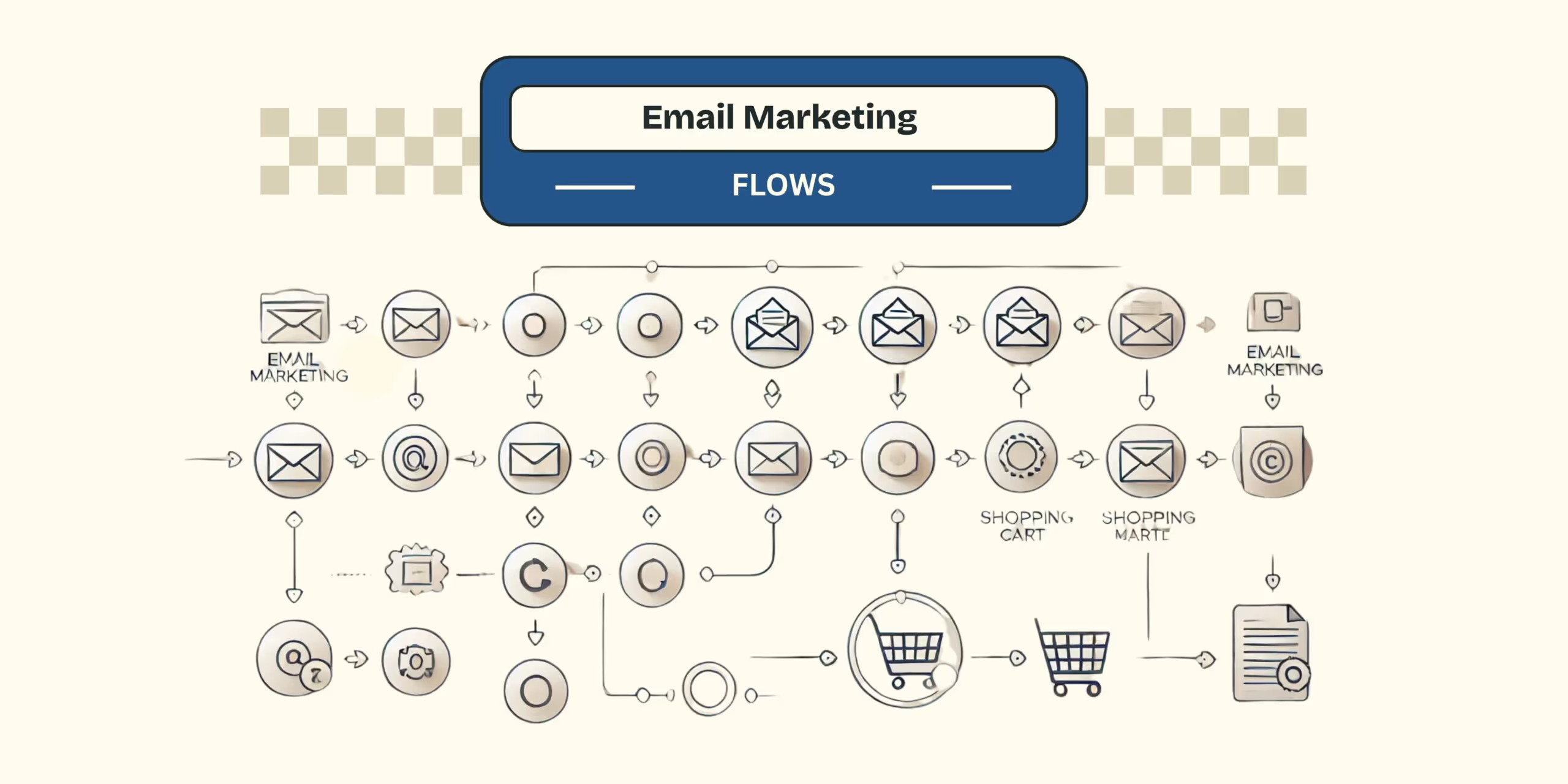
Core Email Marketing Flows: 2025 Essentials for Shopify


Not Sure Where to Start?
Let's find the biggest retention opportunities in your business. Get a free Klaviyo audit or retention consultation.