
Gmail and Yahoo Bulk Sender Requirements: The Compliance Checklist Ecommerce Brands Can't Ignore

Gmail and Yahoo require three things from every bulk sender: full email authentication (SPF, DKIM, and DMARC), one-click unsubscribe support, and spam complaint rates below their enforcement thresholds. Most DTC brands on Klaviyo already qualify as bulk senders — and partial compliance is silently degrading their flow revenue right now.
Every guide on Gmail and Yahoo's sender requirements reads like it was written for an IT administrator or a cold-outreach sender. SPF records. CNAME entries. RFC numbers. None of it tells you where to check compliance inside your Klaviyo account, which gaps damage your revenue the fastest, or what Klaviyo already handles for you.
This article is the 20-minute compliance audit you run inside your own Klaviyo account — with revenue stakes attached to every line item. If you want the complete deliverability picture beyond compliance requirements, start with our email deliverability guide.
Last updated: September 2026
What Are Gmail and Yahoo's Bulk Sender Requirements?
Both Google and Yahoo require bulk senders to authenticate emails with SPF, DKIM, and DMARC, support one-click unsubscribe via the List-Unsubscribe header, and keep spam complaint rates below strict enforcement thresholds. These requirements have been actively enforced since February 2024, with tightening enforcement through 2026.
The requirements break into three categories. Klaviyo is an email and SMS marketing platform widely used by DTC ecommerce brands for automated flows, campaigns, and customer segmentation. Here is what each category means for a brand running it:
Authentication
SPF (Sender Policy Framework) is a DNS record that authorizes specific IP addresses to send email on behalf of your domain. DKIM (DomainKeys Identified Mail) is a cryptographic signature proving an email has not been altered in transit — per Google's sender guidelines, DKIM keys must be at least 1024-bit, with 2048-bit recommended. DMARC (Domain-based Message Authentication, Reporting & Conformance) is a policy instructing receiving servers how to handle messages that fail SPF or DKIM checks. Both Gmail and Yahoo require at least a p=none DMARC policy, and the record must pass alignment — meaning the domain in your DKIM signature or SPF return path matches your visible "From" address.
Reputation
Spam complaint rate is the percentage of delivered emails that recipients report as spam. Per Google's bulk sender requirements, this rate must stay below 0.3%, with Google recommending rates below 0.1%. Yahoo enforces a similar threshold.
Infrastructure
- One-click unsubscribe is a List-Unsubscribe header mechanism (per RFC 8058) that lets recipients unsubscribe from the email client with a single action
- TLS encryption: All email transmitted over encrypted connections
- Valid PTR records: Sending IPs must have valid reverse DNS
- RFC 5322 compliance: Messages must conform to the Internet Message Format standard
Google's email sender guidelines is the official documentation defining the authentication, reputation, and infrastructure standards every sender must meet to reliably deliver email to Gmail inboxes — Google publishes the full specification here. Yahoo's sender requirements is Yahoo Mail's equivalent compliance specification for bulk senders, maintained at senders.yahooinc.com. For the complete authentication setup walkthrough, see our SPF, DKIM, and DMARC guide for DTC brands.
Does Your Ecommerce Brand Qualify as a Bulk Sender?
If your brand sends more than 5,000 messages to Gmail addresses in a single day, per Google's sender guidelines, you are classified as a bulk sender and all enhanced requirements apply permanently. Most growing DTC brands cross this threshold without realizing it, especially during promotional sends or product launches.
The count includes every email to Gmail addresses from your domain: welcome flow emails, cart abandonment sequences, campaign sends, and any transactional messages sent from the same domain. A brand with a 30,000-person email list sending a campaign while automated flows fire in the background can cross 5,000 Gmail recipients in a single day.
Yahoo enforces similar requirements but has not published a specific numeric threshold. In practice, meeting Google's requirements satisfies Yahoo's as well.
What Does Klaviyo Handle Automatically — and What Falls on You?
Klaviyo automatically handles several critical infrastructure requirements including TLS encryption, List-Unsubscribe headers, PTR records, and RFC 5322 formatting — but authentication setup for custom sending domains, DMARC configuration, and ongoing spam complaint rate management are entirely your responsibility as the account owner.
Handled by Klaviyo
- TLS encryption: Enabled by default on all outgoing email
- List-Unsubscribe headers: Automatically added to campaigns and flow emails sent from a branded sending domain
- PTR records and reverse DNS: Managed on Klaviyo's sending infrastructure
- RFC 5322 compliance: Handled by Klaviyo's email rendering engine
Your responsibility
- SPF + DKIM on your custom sending domain: You must add Klaviyo's DNS records to your domain registrar
- DMARC setup and alignment: Configured at your domain's DNS, not inside Klaviyo
- Spam complaint rate management: Your sending practices, list hygiene, and suppression strategy determine this number
- Ongoing verification: Confirming that authentication remains active and properly aligned after DNS changes or domain updates
This split is where most compliance gaps live. Brands assume Klaviyo "handles authentication" — and it does handle the infrastructure layer. But the domain-level authentication and reputation management that Gmail and Yahoo actually evaluate? That is on you.
Which Compliance Gaps Cause the Fastest Revenue Damage?
Spam complaint rate breaches trigger the fastest enforcement response from Gmail and Yahoo — throttling delivery within days. Authentication failures cause slower but compounding inbox placement erosion that builds over weeks. Infrastructure gaps are mostly handled by modern ESPs like Klaviyo. This risk ranking should drive your audit priorities.
Tier 1 — Reputation: highest risk, fix first
- Spam complaint rate below threshold: Per Google's bulk sender requirements, complaints must stay below 0.3%. Breaching this triggers throttling within days — campaigns crater first, then flow delivery follows. This is the highest-risk factor because it depends on subscriber behavior you cannot fully control.
- Sender reputation health: Sender reputation is the composite score Gmail and Yahoo assign to your sending domain based on complaint rates, bounce rates, engagement patterns, and authentication history. Reputation damage compounds — small degradations accumulate into significant delivery failures over weeks.
Tier 2 — Authentication: critical, second priority
- SPF configured and passing: DNS includes the record authorizing Klaviyo's sending IPs
- DKIM active and valid: Keys properly added to DNS, signatures verifying on outbound email
- DMARC published with at least p=none: Record exists in your DNS and passes alignment
- DMARC alignment verified: DMARC alignment is the check confirming your visible "From" domain matches the domain authenticated by SPF or DKIM — the most common hidden compliance failure among brands using custom sending domains
Tier 3 — Infrastructure: mostly automated, verify once
- TLS encryption: Active by default in Klaviyo
- One-click unsubscribe headers: Present on campaigns and branded-domain flow emails
- PTR records: Managed by Klaviyo's infrastructure
- Message formatting: Handled automatically by Klaviyo
How Do You Verify Each Requirement Inside Your Klaviyo Account?
You can verify most compliance requirements directly inside Klaviyo's settings and deliverability dashboard, supplemented by Google Postmaster Tools for Gmail-specific complaint data. The full verification process takes roughly twenty minutes and should be part of your quarterly retention operations review.
- Check your sending domain authentication status. In Klaviyo's account settings, navigate to the sending domains section. Each domain should show SPF and DKIM as verified. If either shows pending or failed, your DNS records need updating — follow our authentication setup guide to resolve it.
- Verify DMARC is published on your domain. DMARC lives in your domain's DNS, not inside Klaviyo. Use a free DMARC lookup tool to confirm your record exists and shows at least
p=none. No DMARC record means non-compliance regardless of your SPF and DKIM status. - Review your spam complaint rate. In Klaviyo's deliverability reports, check complaint rate trends over the last 30, 60, and 90 days. Then verify against Google Postmaster Tools for Gmail-specific data more granular than Klaviyo's aggregate reporting.
- Confirm List-Unsubscribe headers on flow emails. Send yourself a test from a flow — not just a campaign. Open it in Gmail, click the three-dot menu, and look for the "Unsubscribe" option at the top. If it appears on campaigns but not flow emails, your flow sending configuration needs attention.
- Verify DMARC alignment on your custom sending domain. Confirm the "From" domain visible to recipients matches the domain authenticated by DKIM and SPF. Misalignment is the most common hidden failure — authentication passes individually, but DMARC still fails because the domains do not match.
How Do Authentication Failures Silently Erode Flow Revenue?
Authentication failures rarely cause immediate blocks. They gradually reduce inbox placement at Gmail and Yahoo, silently degrading the reach of every automated flow in your Klaviyo account and compounding revenue loss over weeks before the damage becomes visible in your aggregate dashboards.
Automated flows generate an average of $1.94 revenue per recipient according to Blossom's Klaviyo benchmark data — roughly 18 times the revenue per recipient of campaign emails. When authentication failures erode flow delivery, the revenue impact is disproportionately large relative to the volume of emails affected.
A partial authentication failure — DMARC alignment issues on your branded sending domain, for example — does not immediately route emails to spam. Gmail initially defers to other signals. But over weeks, your domain's reputation score drifts downward. Inbox placement drops. Your welcome flow starts missing a growing percentage of new subscribers. Cart abandonment emails reach fewer abandoners each week.
The attribution problem makes it worse. A welcome flow that was converting well gradually drops, and the decline looks like seasonal fluctuation or audience fatigue — not a deliverability problem. By the time the cause is identified, weeks of compounding loss have already occurred. If you are already experiencing deliverability damage, our sender reputation recovery playbook covers the full remediation path.
What Happens When Your Spam Complaint Rate Breaches the Threshold?
When your spam complaint rate crosses the enforcement threshold per Google's bulk sender requirements, Gmail throttles delivery within days. Campaigns are affected first because they send in bulk to large segments. Flow delivery follows shortly after, creating a cascading impact that hits your highest-performing automated sequences.
Unlike authentication failures, complaint rate breaches trigger a fast enforcement response. Gmail actively throttles volume from domains with elevated rates — fewer of your emails are even attempted for delivery. Yahoo responds with similar speed and severity.
For ecommerce brands, complaint rates are the hardest compliance factor to control because they depend on subscriber behavior. A subscriber who does not remember signing up, who receives emails more frequently than expected, or who cannot easily find the unsubscribe link will resort to the spam button. The management strategy starts upstream: clear expectations during signup, consistent send frequency, visible unsubscribe options, and aggressive sunset flows that suppress unengaged subscribers before they become complainers. For the full management playbook, see our deep dive on why the complaint rate threshold is the cliff edge and how to stay well below it.
Do Shopify Transactional Emails Affect Your Bulk Sender Compliance?
Shopify transactional emails send through Shopify's own infrastructure with separate authentication, but they share your root domain's reputation and contribute to your total sending volume — which means they can influence both your bulk sender classification and your domain-level deliverability signals.
DTC brands running Klaviyo alongside Shopify operate a dual-sender system. Klaviyo handles marketing emails from your branded sending domain. Shopify handles transactional emails from its own infrastructure. Two areas need attention:
- Volume contribution: If Shopify transactional emails send from your root domain or a subdomain of it, those volumes count toward how Gmail evaluates your sending patterns. During high-order-volume periods, transactional spikes can push your daily total above the bulk sender threshold even if Klaviyo sends alone would not.
- Authentication consistency: If Klaviyo sends from mail.yourbrand.com with full authentication but Shopify sends from yourbrand.com without proper SPF coverage, the mismatched signals weaken your domain's overall reputation — even though each system's emails may individually pass their own authentication checks.
The fix is straightforward: verify that both Klaviyo and Shopify have proper SPF records covering their respective sending IPs, confirm DKIM is active on both, and ensure your DMARC record accounts for both sending sources. One DMARC policy governs your entire domain — it must work for every system that sends from it.
Run the Checklist. Protect the Revenue.
Running this compliance checklist quarterly takes roughly twenty minutes and protects against the kind of silent revenue erosion that compounds for weeks before it surfaces in your dashboards. The requirements are not complex — the real risk is assuming your setup is fully compliant when it is only partially so.
Start with the highest-risk items: check your spam complaint rate in Google Postmaster Tools, confirm your sending domain authentication status in Klaviyo, and verify that your DMARC record exists and passes alignment. Those three checks catch the compliance gaps that cause the most revenue damage the fastest.
Frequently Asked Questions
Below are the five questions DTC brands on Klaviyo ask most often about Gmail and Yahoo's bulk sender compliance — covering bulk sender classification, automatic unsubscribe headers, complaint rate monitoring in Google Postmaster Tools, DMARC requirements beyond SPF and DKIM, and the practical differences between Gmail and Yahoo's enforcement standards.
What counts as a bulk sender under Gmail's rules?
Any domain that sends more than 5,000 messages to Gmail addresses in a single day, per Google's sender guidelines. The classification is permanent once triggered — all enhanced requirements apply going forward, even on low-volume days. Most DTC brands running Klaviyo cross this threshold during promotional periods without realizing it.
Does Klaviyo add one-click unsubscribe headers automatically?
Yes, for campaign emails and for flow emails sent from a properly configured branded sending domain. Klaviyo includes the List-Unsubscribe and List-Unsubscribe-Post headers required by RFC 8058. Verify by sending yourself a test flow email and checking for the "Unsubscribe" option at the top of the message in Gmail.
How do I monitor my Gmail-specific spam complaint rate?
Register your sending domain with Google Postmaster Tools at postmaster.google.com. It provides Gmail-specific complaint rate data, domain reputation scores, and authentication pass rates broken down by day — more granular and Gmail-specific than Klaviyo's aggregate deliverability dashboard.
Do I need DMARC if I already have SPF and DKIM?
Yes. SPF and DKIM authenticate your emails, but DMARC is a separate requirement that tells receiving servers what to do when those checks fail and confirms alignment between your authentication records and your visible sending domain. Both Gmail and Yahoo explicitly require a published DMARC record with at least p=none. Without it, you fail compliance regardless of SPF and DKIM status.
What is the practical difference between Gmail and Yahoo's requirements?
The core requirements are nearly identical: SPF, DKIM, DMARC, one-click unsubscribe, and low complaint rates. Google publishes a clear 5,000-message daily threshold for bulk sender classification while Yahoo does not specify an exact number. Google also provides more detailed guidance on DKIM key lengths and alignment mechanics. In practice, meeting Google's full requirements satisfies Yahoo's as well.
Deliverability requirements evolve — Google and Yahoo have tightened enforcement multiple times since 2024. Get retention and deliverability tactics in your inbox every week →
Need help implementing this?
Let us take the hassle of managing your email marketing channel off your hands. Book a strategy call with our team today and see how we can scale your revenue, customer retention, and lifetime value with tailored strategies. Click here to get started.
Curious about how your Klaviyo is performing?
We’ll audit your account for free. Discover hidden opportunities to boost your revenue, and find out what you’re doing right and what could be done better. Click here to claim your free Klaviyo audit.
Want to see how we’ve helped brands just like yours scale?
Check out our case studies and see the impact for yourself. Click here to explore.

Read Our Other Blogs

Popup Strategy for Ecommerce: How to Grow Your List Without Training Customers to Wait for Discounts



Email Offer Architecture: How to Structure Promotions That Protect Margin and Still Convert

Klaviyo vs Attentive: Which Platform Is Right for Your DTC Stack in 2026

Spam Complaint Rate: Why 0.3% Is the Cliff Edge and How to Stay Far Below It

Klaviyo Custom Events: How to Track the Ecommerce Behaviors Shopify Doesn't Send by Default

Klaviyo vs Postscript: Choosing Your SMS Platform When You're Already on Klaviyo Email

Repeat Purchase Rate: The Diagnostic Framework for Finding Where Your Second Order Is Breaking Down
Apple Mail Privacy Protection: How to Measure Email Engagement When Opens Are Broken

Back-in-Stock Flow: The Highest-Intent Email Sequence Most Brands Never Build

Klaviyo Predictive Analytics: How to Use CLV, Churn Risk, and Expected Next Order Date to Drive Retention

Email Holdout Testing: How to Prove Your Retention Channel Is Actually Incremental

Klaviyo vs Omnisend: Which ESP Is Right for Your DTC Brand in 2026

Dedicated IP vs Shared IP for Ecommerce Email: When to Switch and When It Backfires

Quiz Funnels for Ecommerce: How to Grow Your List and Segment Subscribers Without Discounts

Klaviyo + Shopify Integration: The Complete Data Sync and Event Tracking Setup Guide

How to Repair Sender Reputation: The Recovery Playbook When Your Emails Land in Spam

Abandoned Cart Flow Strategy: Why Your Recovery Sequence Stops Working After Email One

Ecommerce Email Benchmarks: What Good Actually Looks Like for DTC Brands in 2026

Retention-Focused A/B Testing: What to Test in Email When You've Already Optimized the Basics

Klaviyo Segments vs Lists: How to Structure Your Audience Architecture for Scalable Retention

Email Deliverability for Ecommerce: The Complete Guide to Landing in the Inbox

Klaviyo List Hygiene: How to Clean Your Email List Without Killing Your Revenue

Sunset Flow: How to Win Back Unengaged Subscribers Before You Suppress Them

Welcome Flow Optimization: How to Turn New Subscribers Into First-Time Buyers Faster
Popup Strategy for Ecommerce: How to Grow Your List Without Training Customers to Wait for Discounts
Email Offer Architecture: How to Structure Promotions That Protect Margin and Still Convert
Klaviyo vs Attentive: Which Platform Is Right for Your DTC Stack in 2026

Migrating to Klaviyo: The Step-by-Step Playbook for Switching ESPs Without Losing Revenue

Browse Abandonment Flow: The Underbuilt Sequence Quietly Leaking Revenue

Post-Purchase SMS Flow: How to Use Text Messages to Build Loyalty After the First Order

Retention Marketing Dashboard: The Exact Metrics and Reports You Should Be Reviewing Weekly

Agency vs In-House Email Marketing: What Actually Moves the Needle for DTC Brands

SMS Marketing Strategy for Ecommerce: The Complete Guide

How to Set Up Klaviyo Flows: Complete Setup Guide

A/B Testing for Email: What to Test, How to Measure, When to Ship

Email Marketing KPIs: The Only Metrics That Matter for DTC

Email Revenue Attribution: What Klaviyo Gets Right and Wrong

Popup Strategy for Ecommerce: 6 Types That Actually Convert

RFM Analysis for Ecommerce: Segment Your Customers by Value

Email Segmentation for Ecommerce: The 5-Layer Model for DTC Brands

Welcome Offer Optimization: Converting Subscribers Without Deep Discounts

Email Warmup Strategy: How to Build Sender Reputation From Scratch

Email List Hygiene: How to Clean Your List Without Killing Revenue

SPF, DKIM, and DMARC: Email Authentication Explained for DTC Brands

The Complete Retention Marketing Strategy Guide (2026)

Winback Flow: How to Re-Engage Lapsed Customers Before You Lose Them

How to Audit Your Email Flows (The 125-Point Checklist)

Post-Purchase Email Flow: The Architecture That Drives Repeat Buyers

Sunset Flow: When and How to Remove Unengaged Subscribers

Cart Abandonment Flow: How to Recover Revenue Without Discounting

How to Build a Welcome Flow That Actually Converts

How to Build an Email Campaign Calendar Without Discounting

Browse Abandonment Flow: Converting Window Shoppers Into Buyers

The Abandoned Cart Email Strategy That Actually Recovers Revenue

How to Build a Welcome Flow That Actually Converts

Personalizing Push Notifications for Better Retention Outcomes

How to Craft Email Newsletters That Build Real Brand Loyalty

Top 3 Best eCommerce Content Management Systems of 2025
Email Marketing vs. Social Media: Which One Should Your Brand Focus On?

Attract More Customers: Which Videos to Use in Your Email Marketing and Why
8 eCommerce Customer Service Mistakes You NEED to Stop Making (Like, Yesterday)

Creating The Perfect E-Commerce Tech Stack

Types of Content eCommerce Brands Need in Their Marketing Mix
Ecommerce Email Mistakes: Blossom Ecom Article on How to Stop Sending Bad Emails & Start Making More Money

Boost Your Bottom Line: The Ultimate Guide to Integrating Website and Email Strategies for Your eCommerce Business
6 Powerful Ecommerce Loyalty Program Examples (and How to Build Your Own)
Loyalty-First Guide to Customer Reactivation Email Campaigns
Using Email Marketing to Supercharge Your Loyalty Program

Unpacking Brand and Conversion in E-Commerce Design
13 Scary E-Commerce Mistakes (and How to Avoid Them)

How to Reduce Your E-Commerce Bounce Rate and Boost Engagement

Combining Content and Commerce for E-Commerce Success
Email Marketing Tips + Trends

E-Commerce Returns Analysis & Crafting a Profitable Returns Policy

9 Pro Tips for A/B Testing Emails with HubSpot

AI and Email Marketing: The Future is Here
How to Skyrocket Your Email Open Rates and Click-Through Rates
Email Isn’t Dead: 4 Reasons It’s Still a Digital Marketing Powerhouse

Email Marketing Series – #3: Building a Strong Email List
Email Marketing Series – #4: 9 Tips for Creating High-Impact Email CTAs

Email Marketing Series – #2: How to Craft Attention-Grabbing Subject Lines

Email Marketing vs. Social Media Marketing — Which Should I Use?
Email Marketing Series – #1: Crafting an Effective Email Marketing Strategy
Email Open Rate: A Practical Guide

3 Effective Strategies to Make Email Your Marketing Heavyweight Champion

How to Attract New Leads with Video in Your Email Marketing
How to Determine the Profitability of Your eCommerce Website
Multi-Channel eCommerce: The Key to Growing Your Online Business
Understanding eCommerce Conversion Rate & Optimization
How to Optimize Your eCommerce Website for More Conversions
Top 3 eCommerce and Digital Marketing Trends for 2025

Optimizing Your Email Marketing Strategy: A/B Testing Explained
35 Eye-Opening Email Marketing Stats You Need to Know

7 Email Marketing Tips to Boost Your SEO

11 Common Email Marketing Mistakes That Are Tanking Your Conversions (And How to Fix Them)
Strategic SEO Tips for Email Marketing: Boost Engagement and ROI

How to Measure and Increase Email Marketing ROI (Plus Templates That Convert!)

Do Lifecycle Email Campaigns Really Drive Conversions? Here’s What We Found
How to Use Remailing in Your Email Marketing Strategy

B2B Email Marketing: Building Relationships and Converting Leads
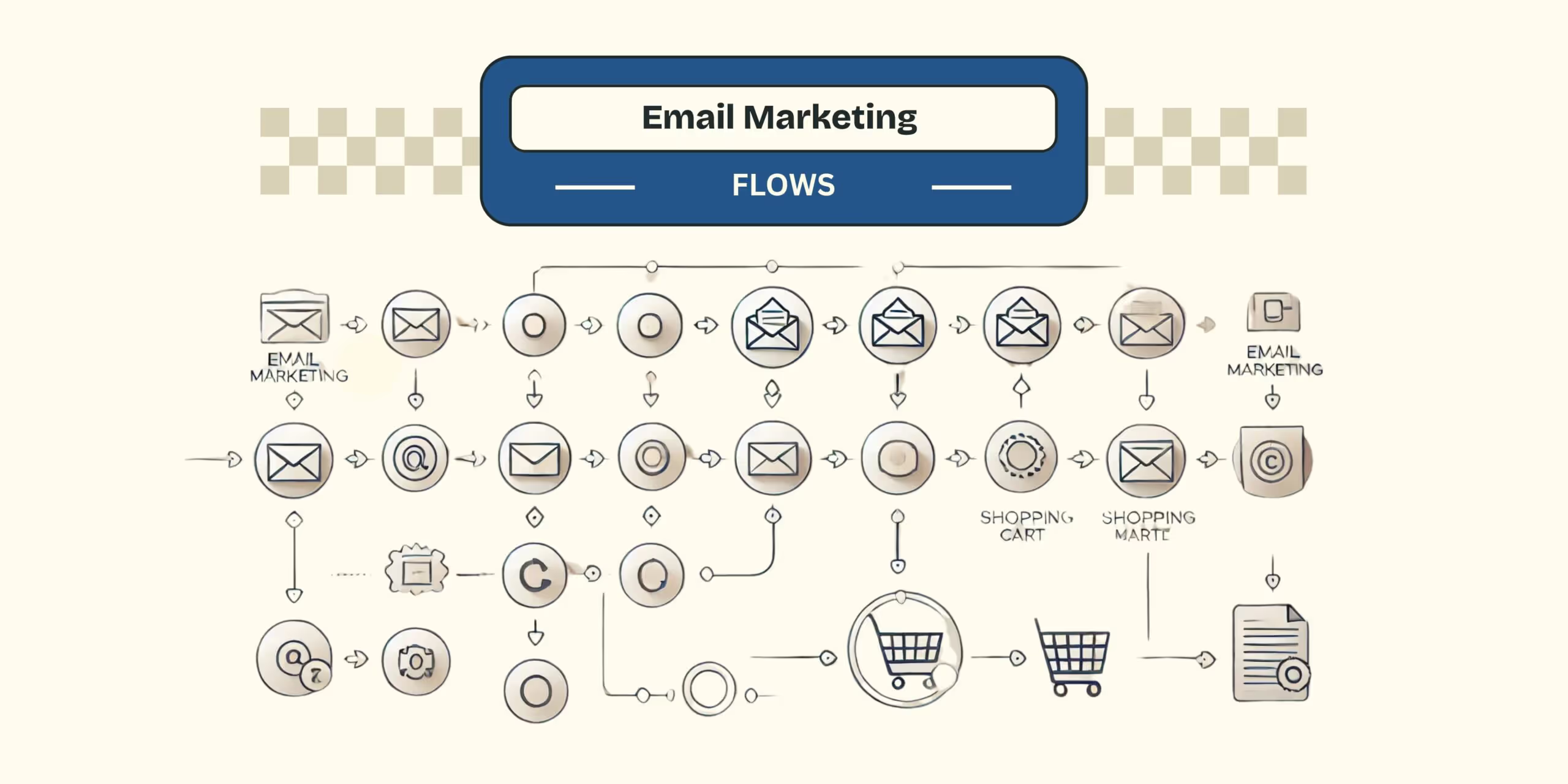
Core Email Marketing Flows: 2025 Essentials for Shopify

Top 5 Revenue-Generating Email Marketing Journeys (Straight from a Klaviyo Partner Agency)

The Long and the Short of It: Getting to “Yes” with Email Marketing


Not Sure Where to Start?
Let's find the biggest retention opportunities in your business. Get a free Klaviyo audit or retention consultation.