

TL;DR: Retention marketing is the practice of systematically extending customer relationships after the first purchase through targeted communication, personalized offers, and lifecycle-timed touchpoints. The most effective retention strategies organize these tactics into four sequential stages — Onboarding, Active Engagement, At-Risk Intervention, and Win-Back — with specific channels, messages, and KPIs mapped to each stage rather than applied at random.
Retention marketing works when it is structured as a sequenced operating system — not a collection of tactics applied whenever someone remembers to send an email. Every customer moves through four distinct lifecycle stages, and the brands that grow fastest are the ones that map specific channels, messages, and KPIs to each stage before deploying a single campaign.
This guide gives you that system. You will get a four-stage retention framework, a self-audit to identify where your revenue is leaking today, a unified KPI map, and a win-back playbook that most ecommerce operators dramatically underinvest in. If you are already running email flows and campaigns but feel like you are leaving money on the table, you are right — and this is where to look.
What Is Retention Marketing, and Why Does It Beat Acquisition?
Retention marketing is the practice of systematically extending customer relationships after the first purchase through targeted communication, personalized offers, and lifecycle-timed touchpoints. It is more capital-efficient than acquisition because the cost of re-engaging a known customer is structurally lower than the cost of persuading a stranger to buy for the first time.
The acquisition vs. retention debate is settled at the unit economics level. Customer acquisition costs have climbed sharply across paid social and search channels, while the mechanics of retention — email, SMS, post-purchase flows — have remained relatively fixed in cost. That gap compounds over time: a brand that converts a meaningful share of first-time buyers into repeat purchasers effectively pays its acquisition cost once and earns from it multiple times.
The practical case for retention is not about avoiding acquisition. It is about maximizing the return on every customer you already paid to acquire.
First-to-second purchase rate is the single most actionable retention metric for most ecommerce brands. Based on Blossom's DTC benchmark data, a rate above 30% is strong; above 40% is elite. Most brands we audit fall well below those thresholds — meaning the majority of all acquired customers are never heard from again.
What Are the 4 Pillars of Retention?
The four pillars of retention marketing are Onboarding, Active Engagement, At-Risk Intervention, and Win-Back. Every customer passes through these stages in sequence, and each stage requires a fundamentally different strategy, message, and measurement approach.
This is the core diagnostic insight that most retention guides miss: they present tactics without telling you which stage those tactics belong to. A win-back discount sent to a customer in the onboarding stage trains them to wait for deals before they have even decided they like the product. A heavy educational sequence sent to a lapsed customer who already knows the brand wastes the narrow re-engagement window you have.
The framework below — what we call the Retention Operating System (ROS) — maps tactics to stages so you are always applying the right lever at the right moment.
Stage 1: Onboarding (Days 0–30)
The first 30 days after a first purchase determine whether a customer will ever return. This window has the highest emotional engagement, the highest deliverability rates, and the highest leverage for building the behaviors that drive long-term retention. Most churn is decided here — not at month six.
The goals for this stage are narrow and specific:
- Confirm the purchase was the right decision (reduce buyer's remorse)
- Deliver product education that increases perceived value
- Collect a review while satisfaction is at its peak
- Plant the first cross-sell at the moment complementary value is most apparent
Key flows for this stage: Post-purchase sequence (5–7 emails over 30 days for first-time buyers), transactional SMS, and a review request. According to Blossom's benchmark data, a well-built post-purchase flow targeting new buyers drives a 60-day repeat purchase rate of 15–30%. The cross-sell click rate in post-purchase emails runs 3–8% according to Blossom's Klaviyo benchmark data — modest on its own, but compounding across your entire new-buyer volume.
Stage exit KPI: Second purchase rate within 60 days.
Stage 2: Active Engagement (Days 31–120)
Customers who made a second purchase have validated the brand. The objective shifts from conversion to frequency and average order value. This is where the ongoing campaign cadence — product launches, educational sends, social proof, and promotions — does the most work.
The critical mistake at this stage is treating all active customers identically. Engagement-based segmentation is essential here. Recency, Frequency, Monetary (RFM) modeling is a customer analysis methodology that scores buyers on how recently they purchased, how often they purchase, and how much they spend — providing a structured framework for prioritizing retention communication by customer value.
In practice, the most actionable split is between one-time buyers (still in Stage 1 territory), repeat buyers (your core active segment), and VIPs (typically your top results that vary by program of customers by revenue, usually 4+ purchases). Each group should receive different campaign content — not just the same email with different subject lines.
Stage exit KPI: Purchase frequency over the prior 90 days.
Stage 3: At-Risk (Days 60–120 of inactivity)
A customer becomes at-risk when their engagement pattern breaks. They were opening and clicking regularly — then they stopped. The window between first sign of disengagement and permanent churn is your most underutilized intervention opportunity.
Churn rate is the percentage of customers who stop purchasing within a defined period, calculated by dividing lapsed customers by total active customers at the start of that period. For most ecommerce brands operating on 30–60 day replenishment cycles, a customer with no purchase or engagement activity in 75+ days is statistically at risk of not returning.
At-risk intervention does not lead with discounts. It leads with value recovery — reminding the customer what they liked about the brand, introducing what is new, and only escalating to an incentive if engagement signals remain absent after the first two touches.
Stage exit KPI: Re-engagement rate (any click or purchase within the intervention window).
Stage 4: Win-Back (90+ Days of Inactivity)
Win-back is the most underinvested stage in most ecommerce retention programs. Brands that do run win-back campaigns typically lead with a blanket discount code sent to their entire lapsed segment — which both trains deal-seeking behavior and misses the customers who would have returned for value-led reasons alone.
A structured win-back sequence escalates from emotional reconnection to product novelty to incentive to final offer, each email serving a distinct psychological function. The escalation framework matters because different lapsed customers respond to different triggers — and sending everyone your maximum discount on email one leaves no room to negotiate.
According to Blossom's benchmark data, win-back flows convert at 2–5% and generate $2–6 RPR. Those numbers look modest, but applied to a lapsed segment of several thousand customers, the revenue is real — and these are customers you already paid to acquire.
Stage exit KPI: Win-back conversion rate; re-entry into the active engagement stage.
How Do You Audit Your Retention Program Before Adding More Tactics?
A retention audit maps your current program against the four lifecycle stages and identifies where the largest revenue gaps exist. Without this diagnostic step, most teams optimize the wrong stage — building elaborate win-back campaigns while their onboarding flow is still losing new customers in the first 30 days.
Before building or optimizing anything, answer these 12 questions across the four stages. Score each area 1–5 (1 = missing or broken, 5 = optimized and performing).
Onboarding Audit (Stage 1)
- Does a post-purchase flow exist for first-time buyers beyond the order confirmation email?
- Does the flow include product education, a review request, and a cross-sell before day 30?
- Is the 60-day second purchase rate tracked and benchmarked?
Active Engagement Audit (Stage 2)
- Are active buyers segmented by purchase tier (one-time, repeat, VIP) for campaign targeting?
- Is the campaign content mix balanced — less than numbers that depend on your setup promotional, with educational and social proof sends filling the rest?
- Are VIP customers excluded from discount-led campaigns?
At-Risk Audit (Stage 3)
- Is there an automated trigger when a customer's engagement or purchase pattern breaks?
- Does the at-risk sequence lead with value before escalating to an offer?
- Is churn rate tracked by cohort and reviewed at least monthly?
Win-Back Audit (Stage 4)
- Does a win-back flow exist with at least three emails?
- Does the sequence escalate (value → novelty → offer → final) rather than leading with the maximum discount?
- Are customers who do not respond to win-back routed to a sunset suppression list?
Any stage scoring below a 3 across its three questions is your highest-priority retention investment — regardless of what else looks attractive on paper.
If you want the full printable version of this scorecard, download it below.
Download the Retention Audit Scorecard — Free PDF
A printable 12-question diagnostic tool mapped to the four ROS lifecycle stages. Identify your biggest revenue leak before spending another hour on tactics.
What Is the 80/20 Rule in Customer Retention?
The 80/20 rule in customer retention holds that performance that shifts with your audience of a brand's repeat revenue tends to come from approximately 20% of its customers. In practice, this means a small segment of high-frequency, high-LTV buyers is responsible for the majority of retention-driven revenue — and protecting that segment deserves disproportionate investment.
The practical implications for ecommerce operators are specific. Your VIP segment — typically the top figures that differ across accounts of customers by revenue — should never receive the same blanket promotional emails as your general list. Discounting your best customers trains them to wait for deals. Excluding them from discount campaigns while giving them early access, exclusive products, and personal recognition retains the behavior (full-price purchasing) that makes them VIPs in the first place.
Customer Lifetime Value (CLV) is the total revenue a customer is projected to generate across their entire relationship with a brand, calculated by multiplying average order value by purchase frequency by expected customer lifespan. CLV is the most important number in the 80/20 framework because it makes the value concentration visible: your top customers by CLV are not just buying more often, they are staying longer.
The diagnostic application: if you pull your customer list and sort by total lifetime revenue, the top outcomes tied to your specific list of customers are your retention infrastructure. Build specifically for them.
What Is the 3-3-3 Rule in Marketing?
In the retention context, the 3-3-3 rule refers to the principle that a customer needs three meaningful brand interactions across three different touchpoints within the first three weeks after purchase to develop the repeat-buying habit. It is a heuristic for structuring post-purchase communication density during the highest-leverage retention window.
Applied to the onboarding stage of the ROS framework, the 3-3-3 rule translates into a post-purchase sequence that covers product education, social proof (community belonging), and a utility touchpoint — such as a usage guide, review request, or complementary product suggestion — before day 21. The specific channels matter less than the cadence: the goal is three distinct value-delivery moments before the customer's attention fully moves on.
What Retention Marketing Channels Have the Highest ROI for Ecommerce?
Email flows consistently generate the highest retention ROI because their cost is fixed regardless of volume and their targeting precision compounds over time. SMS adds high-urgency amplification at specific moments but degrades quickly when overused. The combination of lifecycle email flows plus strategically placed SMS is the highest-performing retention channel stack for most DTC brands.
Here is how the primary retention channels perform in practice:
- Post-purchase email flows: Highest long-term ROI because they run on autopilot and directly address the first-to-second-purchase gap. According to Blossom's Klaviyo benchmark data, well-optimized post-purchase flows drive 60-day repeat purchase rates of 15–30%.
- Win-back email sequences: $2–6 RPR according to Blossom's benchmark data — modest per recipient, but applied to a lapsed segment of thousands, significant in aggregate.
- SMS in flows: According to Blossom's DTC benchmark data, SMS click rates run 8–15% in flow contexts where the message is behaviorally triggered and relevant. The same brand sending weekly SMS blasts to their full list will typically see opt-out rates climb above results that vary by program within 30 days.
- Welcome flows: Technically an acquisition-to-retention bridge. Welcome flows typically generate $3–8 RPR according to Blossom's benchmark data, with first-email open rates of 50–70%.
- Loyalty and VIP flows: Lower volume, highest revenue per recipient. VIP customers drive a disproportionate share of repeat revenue, and early access and exclusivity programs retain their purchasing behavior without margin-eroding discounts.
Net Revenue Retention (NRR) is a SaaS-originated metric that measures the percentage of revenue retained from an existing customer cohort over a period, including expansions and contractions. While originally a subscription-model concept, NRR thinking is increasingly applied by DTC subscription and replenishment brands to measure whether their average customer is spending more or less over time — making it a useful complement to CLV tracking for consumable product businesses.
For platform-specific guidance on building retention flows, Klaviyo's flow documentation provides detailed technical setup instructions, and Braze's lifecycle marketing resource library offers complementary strategic frameworks for multi-channel retention programs.
How Do You Build a Win-Back Campaign That Actually Converts?
A win-back campaign converts best when it escalates across four distinct emails — emotional reconnection, value and novelty, a time-bounded incentive, and a final offer with a sunset warning — rather than leading with the maximum discount on the first message.
The escalation logic matters because lapsed customers leave for different reasons. Some drifted out of habit. Some had a poor experience they have half-forgotten. Some switched to a competitor but are not loyal to them yet. The customer who left because they forgot you exist will return for a compelling "here's what you missed" email. Sending them a numbers that depend on your setup off code on message one is unnecessary margin erosion — and it signals to the customers who need the offer that your prices are negotiable.
Here is the four-email structure that performs consistently according to Blossom's DTC benchmark data:
- Email 1 — Reconnection (Day 0): No offer. Emotional tone. Show what is new since they last visited. Remind them why they came in the first place. Subject line direction: curiosity or brand narrative, not urgency.
- Email 2 — Value and novelty (Day 5): New products, bestsellers they may have missed, customer stories. Still no discount. You are rebuilding the case for why this brand deserves their attention.
- Email 3 — Incentive (Day 10): Your offer, with a real deadline. performance that shifts with your audience off is the typical range for most DTC brands. The deadline must be genuine — a countdown that resets when the email is reopened destroys trust faster than any other tactic in email marketing.
- Email 4 — Final offer and sunset warning (Day 17): Best offer, honest framing. "This is the last email we'll send unless you'd like to stay." Respects the customer's inbox and your list health simultaneously.
RFM-based segmentation for the win-back audience improves results meaningfully. A customer who made five purchases before lapsing is worth a different incentive than someone who made one. Customer segmentation is the practice of dividing a customer base into groups with similar behavioral or demographic characteristics so that each group can receive communication specifically relevant to their relationship with the brand — and in win-back, the most important segmentation axis is lifetime value before lapse.
Any customer who does not respond after email four should move to a sunset suppression list — not deleted, but removed from all campaign sends. Emailing disengaged contacts depresses inbox placement for your entire list, including your best customers.
Want to see how your win-back sequence compares? The Retention Audit Scorecard includes a win-back diagnostic that takes less than five minutes.
Download the Scorecard →How Do You Measure the Success of a Retention Marketing Strategy?
Retention strategy success is measured by aligning specific KPIs to each lifecycle stage — not by tracking all metrics simultaneously. The KPI that matters most in onboarding (second purchase rate) is irrelevant in win-back (re-engagement rate), and conflating them produces dashboards that look busy without revealing where the program is actually breaking down.
Here is the unified retention KPI map, with each metric assigned to the stage where it is most actionable:
- Stage 1 — Onboarding: 60-day second purchase rate (target: 30%+), post-purchase flow conversion rate, review submission rate (5–15% according to Blossom's Klaviyo benchmark data)
- Stage 2 — Active Engagement: Purchase frequency (trailing 90 days), average order value trend, campaign RPR by segment, VIP segment retention rate
- Stage 3 — At-Risk: Churn rate by cohort, at-risk intervention re-engagement rate, time from last purchase to first at-risk trigger
- Stage 4 — Win-Back: Win-back conversion rate (2–5% according to Blossom's benchmark data), re-engagement rate across the sequence, sunset suppression growth rate (a growing suppression list signals an upstream onboarding or engagement problem)
Net Promoter Score (NPS) is a customer loyalty metric derived from a single survey question — how likely are you to recommend this brand to a friend — scored on a 0–10 scale and reported as the percentage of promoters (9–10) minus detractors (0–6). NPS is most useful as a leading indicator in the onboarding stage: a low NPS from recent first-time buyers predicts elevated churn before the behavioral data catches up.
Repurchase rate is the percentage of customers who make more than one purchase within a defined period, typically 90 or 365 days. It is the most straightforward top-line indicator of retention program health and the number most directly connected to CLV growth.
Frequently Asked Questions About Retention Marketing Strategy
What is the difference between retention marketing and acquisition marketing?
Retention marketing targets customers who have already purchased, using behavioral data and lifecycle timing to extend and deepen the relationship. Acquisition marketing targets new audiences with no prior purchase history. The fundamental difference is data richness: retention marketing operates on known behavior, making personalization and timing precision possible in ways that acquisition cannot replicate.
How do you build a retention marketing strategy for a small business with limited resources?
Start with the two flows that generate the highest retention ROI relative to build time: a post-purchase email sequence for first-time buyers and a win-back sequence for lapsed customers. These two flows address the most common revenue leak in small ecommerce businesses — the first converts new customers into repeat buyers before the relationship goes cold, and the second recovers the customers already in your database before they are permanently lost. Both can be built in a platform like Klaviyo without advanced technical resources.
What is a customer lifecycle email sequence?
A customer lifecycle email sequence is an automated series of emails triggered by a customer's stage in their relationship with a brand — not by a calendar date. The sequence changes in message, tone, and objective depending on whether the customer is newly acquired, actively purchasing, showing signs of lapse, or fully disengaged. Lifecycle sequences outperform broadcast campaigns because they are contextually relevant to where the customer actually is.
How often should you send retention marketing emails?
Send frequency should match the customer's engagement tier. Customers who clicked an email in the last 30 days can sustain 3–4 campaign emails per week. Customers who have not clicked in 45–60 days should receive no more than 1–2 emails per week, reserved for your highest-quality content. Customers with no engagement in 90+ days should receive only a win-back or sunset sequence — never routine campaigns. Sending full-frequency campaigns to disengaged contacts damages your sender reputation and reduces inbox placement for your engaged segment.
How do you reduce churn with lifecycle email marketing?
Reduce churn by intervening at the stage before it becomes permanent. Build a behavioral trigger that fires when a customer's engagement pattern breaks — typically 45–60 days of no purchase or email interaction, depending on your replenishment cycle. Route those customers into an at-risk sequence that leads with value, not an immediate discount. The customers who respond to the value-first messaging are your highest-quality re-engagements; the customers who only respond to the discount offer need a different relationship expectation. Both outcomes are useful signals.
Building Your Retention Operating System: Where to Start
The most common mistake in retention marketing is treating it as an ongoing list of tactics to add rather than a system to build and sequence. Adding a loyalty program before fixing a broken post-purchase flow is like adding a second floor to a house with a cracked foundation.
The sequence that consistently produces results across DTC brands of different sizes follows the same logic as the audit scorecard above:
- Fix the onboarding stage first — build or optimize the post-purchase flow until your 60-day second purchase rate is above figures that differ across accounts.
- Segment your active buyers by purchase tier and stop sending identical campaigns to one-time buyers, repeat buyers, and VIPs simultaneously.
- Build the at-risk trigger and value-first intervention sequence before it becomes a win-back problem.
- Build a win-back sequence with proper escalation, connected to a sunset suppression list.
- Optimize each stage with the KPIs mapped to that stage — not a single top-line metric that hides where the system is breaking down.
The Retention Audit Scorecard is the fastest way to see which stage needs the most work in your current program. It takes less than ten minutes to complete and gives you a prioritized roadmap rather than another list of things to try.
Want a second set of eyes on your retention program? We review your lifecycle audit results and identify the highest-leverage opportunities for your specific brand.
Book a Free Retention Consultation →Need help implementing this?
Let us take the hassle of managing your email marketing channel off your hands. Book a strategy call with our team today and see how we can scale your revenue, customer retention, and lifetime value with tailored strategies. Click here to get started.
Curious about how your Klaviyo is performing?
We’ll audit your account for free. Discover hidden opportunities to boost your revenue, and find out what you’re doing right and what could be done better. Click here to claim your free Klaviyo audit.
Want to see how we’ve helped brands just like yours scale?
Check out our case studies and see the impact for yourself. Click here to explore.

Read Our Other Blogs

Klaviyo Custom Events: How to Track the Ecommerce Behaviors Shopify Doesn't Send by Default



Klaviyo vs Postscript: Choosing Your SMS Platform When You're Already on Klaviyo Email

Repeat Purchase Rate: The Diagnostic Framework for Finding Where Your Second Order Is Breaking Down

VIP Early Access Campaigns: How to Reward Best Customers Without Giving Anything Away

Gmail and Yahoo Bulk Sender Requirements: The Compliance Checklist Ecommerce Brands Can't Ignore

Spam Complaint Rate: Why 0.3% Is the Cliff Edge and How to Stay Far Below It
Klaviyo Custom Events: How to Track the Ecommerce Behaviors Shopify Doesn't Send by Default
Klaviyo vs Postscript: Choosing Your SMS Platform When You're Already on Klaviyo Email
Repeat Purchase Rate: The Diagnostic Framework for Finding Where Your Second Order Is Breaking Down
Apple Mail Privacy Protection: How to Measure Email Engagement When Opens Are Broken

Back-in-Stock Flow: The Highest-Intent Email Sequence Most Brands Never Build

Klaviyo Predictive Analytics: How to Use CLV, Churn Risk, and Expected Next Order Date to Drive Retention

Email Holdout Testing: How to Prove Your Retention Channel Is Actually Incremental

Klaviyo vs Omnisend: Which ESP Is Right for Your DTC Brand in 2026

Dedicated IP vs Shared IP for Ecommerce Email: When to Switch and When It Backfires

Quiz Funnels for Ecommerce: How to Grow Your List and Segment Subscribers Without Discounts

Klaviyo + Shopify Integration: The Complete Data Sync and Event Tracking Setup Guide

How to Repair Sender Reputation: The Recovery Playbook When Your Emails Land in Spam

Abandoned Cart Flow Strategy: Why Your Recovery Sequence Stops Working After Email One

Ecommerce Email Benchmarks: What Good Actually Looks Like for DTC Brands in 2026
Retention-Focused A/B Testing: What to Test in Email When You've Already Optimized the Basics

Klaviyo Segments vs Lists: How to Structure Your Audience Architecture for Scalable Retention

Email Deliverability for Ecommerce: The Complete Guide to Landing in the Inbox

Klaviyo List Hygiene: How to Clean Your Email List Without Killing Your Revenue

Sunset Flow: How to Win Back Unengaged Subscribers Before You Suppress Them

Welcome Flow Optimization: How to Turn New Subscribers Into First-Time Buyers Faster

Popup Strategy for Ecommerce: How to Grow Your List Without Training Customers to Wait for Discounts

Email Offer Architecture: How to Structure Promotions That Protect Margin and Still Convert

Klaviyo vs Attentive: Which Platform Is Right for Your DTC Stack in 2026

Migrating to Klaviyo: The Step-by-Step Playbook for Switching ESPs Without Losing Revenue

Browse Abandonment Flow: The Underbuilt Sequence Quietly Leaking Revenue

Post-Purchase SMS Flow: How to Use Text Messages to Build Loyalty After the First Order

Retention Marketing Dashboard: The Exact Metrics and Reports You Should Be Reviewing Weekly

Agency vs In-House Email Marketing: What Actually Moves the Needle for DTC Brands

SMS Marketing Strategy for Ecommerce: The Complete Guide

How to Set Up Klaviyo Flows: Complete Setup Guide

A/B Testing for Email: What to Test, How to Measure, When to Ship

Email Marketing KPIs: The Only Metrics That Matter for DTC

Email Revenue Attribution: What Klaviyo Gets Right and Wrong

Popup Strategy for Ecommerce: 6 Types That Actually Convert

RFM Analysis for Ecommerce: Segment Your Customers by Value

Email Segmentation for Ecommerce: The 5-Layer Model for DTC Brands
Welcome Offer Optimization: Converting Subscribers Without Deep Discounts

Email Warmup Strategy: How to Build Sender Reputation From Scratch

Email List Hygiene: How to Clean Your List Without Killing Revenue

SPF, DKIM, and DMARC: Email Authentication Explained for DTC Brands

Winback Flow: How to Re-Engage Lapsed Customers Before You Lose Them

How to Audit Your Email Flows (The 125-Point Checklist)

Post-Purchase Email Flow: The Architecture That Drives Repeat Buyers

Sunset Flow: When and How to Remove Unengaged Subscribers

Cart Abandonment Flow: How to Recover Revenue Without Discounting

How to Build a Welcome Flow That Actually Converts

How to Build an Email Campaign Calendar Without Discounting

Browse Abandonment Flow: Converting Window Shoppers Into Buyers

The Abandoned Cart Email Strategy That Actually Recovers Revenue

How to Build a Welcome Flow That Actually Converts
Personalizing Push Notifications for Better Retention Outcomes
How to Craft Email Newsletters That Build Real Brand Loyalty
Top 3 Best eCommerce Content Management Systems of 2025
Email Marketing vs. Social Media: Which One Should Your Brand Focus On?
Attract More Customers: Which Videos to Use in Your Email Marketing and Why
8 eCommerce Customer Service Mistakes You NEED to Stop Making (Like, Yesterday)
Creating The Perfect E-Commerce Tech Stack

Types of Content eCommerce Brands Need in Their Marketing Mix
Ecommerce Email Mistakes: Blossom Ecom Article on How to Stop Sending Bad Emails & Start Making More Money
Boost Your Bottom Line: The Ultimate Guide to Integrating Website and Email Strategies for Your eCommerce Business
6 Powerful Ecommerce Loyalty Program Examples (and How to Build Your Own)
Loyalty-First Guide to Customer Reactivation Email Campaigns
Using Email Marketing to Supercharge Your Loyalty Program
Unpacking Brand and Conversion in E-Commerce Design
13 Scary E-Commerce Mistakes (and How to Avoid Them)
How to Reduce Your E-Commerce Bounce Rate and Boost Engagement
Combining Content and Commerce for E-Commerce Success
Email Marketing Tips + Trends

E-Commerce Returns Analysis & Crafting a Profitable Returns Policy

9 Pro Tips for A/B Testing Emails with HubSpot
AI and Email Marketing: The Future is Here
How to Skyrocket Your Email Open Rates and Click-Through Rates
Email Isn’t Dead: 4 Reasons It’s Still a Digital Marketing Powerhouse

Email Marketing Series – #3: Building a Strong Email List
Email Marketing Series – #4: 9 Tips for Creating High-Impact Email CTAs

Email Marketing Series – #2: How to Craft Attention-Grabbing Subject Lines
Email Marketing vs. Social Media Marketing — Which Should I Use?
Email Marketing Series – #1: Crafting an Effective Email Marketing Strategy
Email Open Rate: A Practical Guide
3 Effective Strategies to Make Email Your Marketing Heavyweight Champion

How to Attract New Leads with Video in Your Email Marketing
How to Determine the Profitability of Your eCommerce Website
Multi-Channel eCommerce: The Key to Growing Your Online Business
Understanding eCommerce Conversion Rate & Optimization
How to Optimize Your eCommerce Website for More Conversions
Top 3 eCommerce and Digital Marketing Trends for 2025

Optimizing Your Email Marketing Strategy: A/B Testing Explained
35 Eye-Opening Email Marketing Stats You Need to Know
7 Email Marketing Tips to Boost Your SEO
11 Common Email Marketing Mistakes That Are Tanking Your Conversions (And How to Fix Them)
Strategic SEO Tips for Email Marketing: Boost Engagement and ROI
How to Measure and Increase Email Marketing ROI (Plus Templates That Convert!)

Do Lifecycle Email Campaigns Really Drive Conversions? Here’s What We Found
How to Use Remailing in Your Email Marketing Strategy

B2B Email Marketing: Building Relationships and Converting Leads
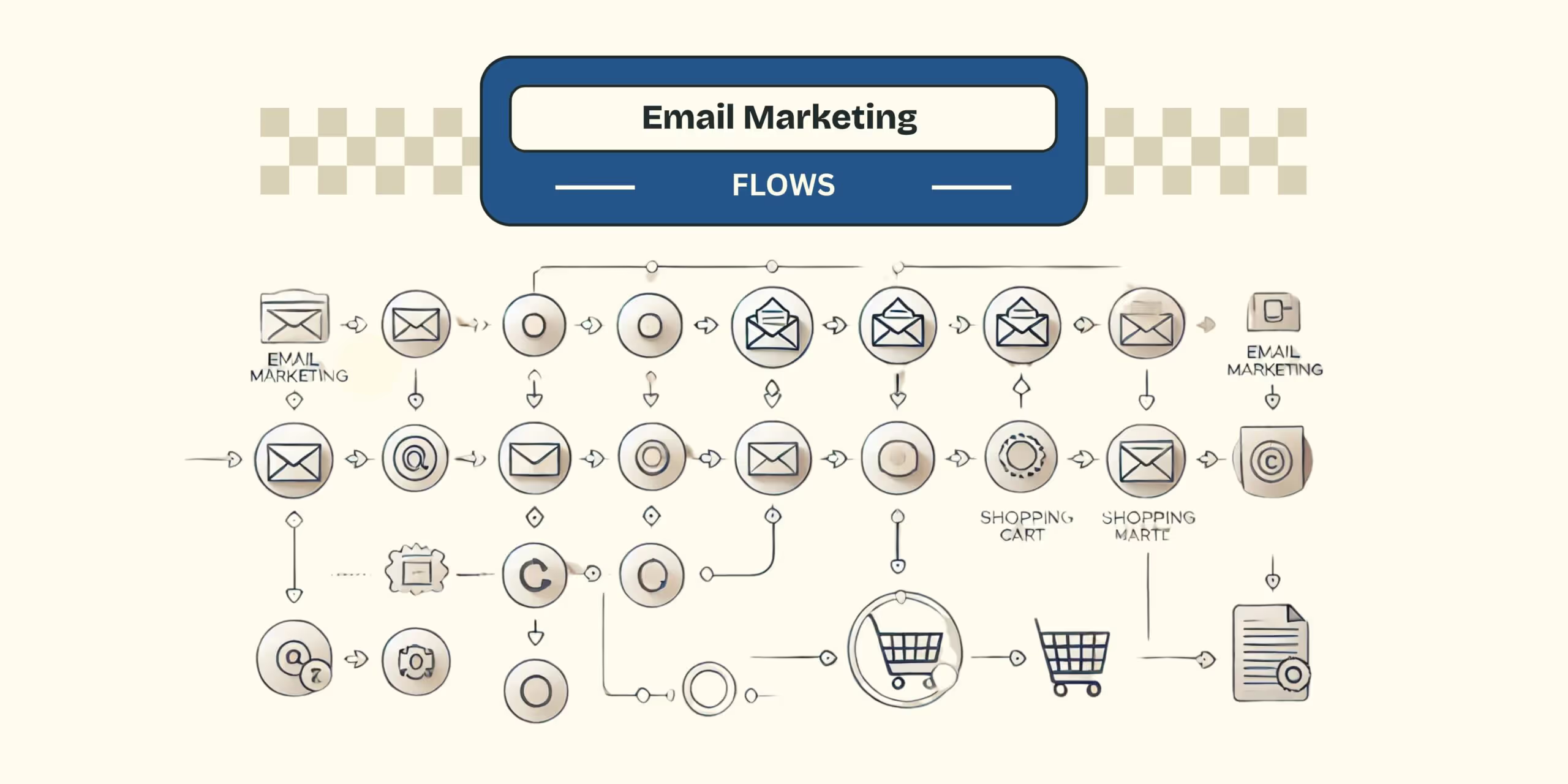
Core Email Marketing Flows: 2025 Essentials for Shopify

Top 5 Revenue-Generating Email Marketing Journeys (Straight from a Klaviyo Partner Agency)


Not Sure Where to Start?
Let's find the biggest retention opportunities in your business. Get a free Klaviyo audit or retention consultation.